Between Oxford and Rome
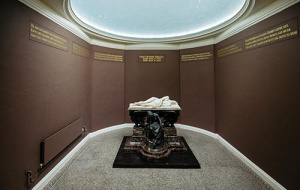
The Shelley Memorial, University College, Oxford
In the shadow of Shelley
“Go thou to Rome—at once the Paradise,
The grave, the city, and the wilderness;
[…]
Rome’s azure sky,
Flowers, ruins, statues, music, words, are weak
The glory they transfuse with fitting truth to speak.”
Thus read the lines from Percy Bysshe Shelley’s poem Adonais that decorate the interior of the Univ Shelley Memorial, written in memory of his friend John Keats. During a sweltering week in August 2018, I worked as a tour guide for Univ, taking the visitors who streamed through the gate each day through the College’s history, student life, and, crucially, introducing them to Percy Shelley the College tortoise. While trying my best both to impress the visitors and the late, great Head Porter Bob Maskell, who had taken me through the main facts and details, a key moment of every tour was when we could hide from the heat amongst the cool stone of the Shelley Memorial. Together with tourists from the US to Japan, I speculated over the verity of the old story of a student prank involving water and rubber ducks (or goldfish?) We marvelled at the “strangely feminine aspects” of Shelley’s prostrate form, admiration occasionally “coupled with the uncomfortable realisation that one is being invited to linger over the beauty of a drowned corpse washed ashore” (Dr Robin Darwall-Smith, A History of University College Oxford).
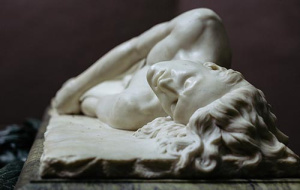
The Shelley Memorial, University College, Oxford (close up)
As a student, the vision of Shelley washed up on the Viareggio shore under golden stars held enough pathos to stop me in my tracks as I rushed past on the way to a friend or a tutorial in 90 High Street. Of course, its subject was sent down after only a year at Univ for “contumaciously refusing to answer questions proposed to [him], and for also repeatedly declining to disavow a publication entituled The Necessity of Atheism” (The College Register, 1811). Subsequently, he became one of England’s greatest Romantic poets, crossing Europe with his wife Mary. He drowned in the Ligurian Sea in 1822.
A couple of months ago, I visited the final resting place of Shelley and Keats, a peaceful, sun-dappled place tucked behind a quiet Testaccio street, near the ancient Piramide in Italy. The Non-Catholic Cemetery of Rome is where the Univ Memorial was originally destined to be, but was deemed too big for the site by the daughter of Edward Trelawny, who is buried next to Shelley. And so Shelley’s daughter-in-law Jane offered the Memorial instead to his old college. Soon, the familiar domed ceiling crowned the High Street wall, a link between the two cities.
Walking north along the Tiber, passing some of the most famous ancient sites of the Eternal City, you will find the true jewel of literary Rome in the hubbub of Piazza di Spagna: The Keats-Shelley House. Rising up alongside the iconic Spanish Steps, this wonderful museum is dedicated to the Romantic poets who lived in and visited Rome, particularly Shelley and Keats, the latter of whom died in the House; a pilgrimage spot for enthusiasts of the Romantics.
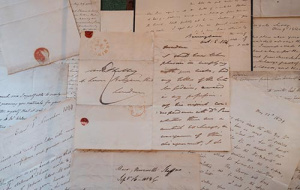
Close up of the William Godwin letters
I first visited the Keats-Shelley House with my parents after my first two terms of Univ in the Spring of 2017, and felt I’d stepped right into the 19th century and found a quiet haven in the heart of the gloriously chaotic Italian capital. Now my husband (a fellow Univite) and I are spending more time in Rome, this continues to be the case. The House welcomes the visitors who cross its threshold and climb its winding stairs with regular events, exhibitions, and wonderful treasures, along with the comforting scent of old books to boot. Indeed, it houses one of the best libraries of Romantic literature in the world, now with more than 8,000 volumes. As with the Memorial back in Oxford, its cool interior is welcome respite from the heat outside.
A team of American and British supporters secured the sale of the House in the early twentieth century, a group that included Edith Wharton and Rudyard Kipling. It remains a tribute to English-language writers who have lived in Italy, from Henry James to Oscar Wilde and George Eliot. There you can learn of the House’s history, including the daring story of its life “underground” during WWII, where the curator hid its collection from German inspection in the Abbey of Montecassino. The collection now includes Mary Shelley’s beautiful travel-writing slope and a vast array of manuscripts, letters, and artworks and books that belonged to Keats, Shelley and Byron. There is even an urn containing a fragment of Percy’s jawbone.
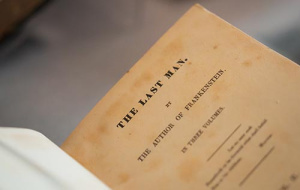
The Last Man Vol. II (detail)
Percy and John died young, aged twenty-five and twenty-nine respectively, and they were survived by their friends and admirers; and, in Percy’s case, by his wife Mary. It is her and her extraordinary legacy, including Frankenstein, that the House is celebrating in a new exhibition from late May–November this year. “A World on the Verge” marks the bicentenary of the publication of her remarkably prescient novel The Last Man, a speculative tale of humanity’s extinction caused by a global pandemic. In the House’s words, the exhibition combines “autograph letters, first editions, paintings, and contemporary artworks, offering visitors an immersive journey through biography and dystopian imagination.”
I have worked in publishing leaving Univ, and long before today’s bookshelves were plentifully stocked with sci-fi, speculative and dystopian novels, Mary Shelley used a fictional future to pinpoint what she considered to be the vices and fragility of the all-too-real society around her. The exhibition promises to bring her lesser-known work back into the limelight, while continuing to celebrate the lasting inspirational legacy of a visionary writer. I would wholeheartedly recommend anyone planning a trip to Rome this year to venture through the wooden door at the foot of the Spanish Steps and look around in wonder.
Recently, my husband and I had the great joy of returning to Univ for the 2013-2016 Gaudy and for our MA graduation with a group of friends. On both occasions, I wandered through the doorway leading to New Buildings and found myself standing in front of that great Romantic poet (and namesake of a great tortoise), looking up at the stars of “Rome’s azure sky” shimmering in the centre of Oxford. I’ve often wondered what he would think of his own statue lying there within the walls of his alma mater. I, for one, am grateful it is there.
Matilda Warner (2016, English)
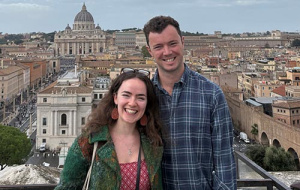
Mati Warner and husband Patrick in Rome
This feature was adapted from one first published in Issue 18 of The Martlet; read the full magazine here or explore our back catalogue of Martlets below:




Explore Univ on social media