Across the Aegean: A travel diary
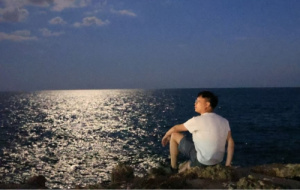 Roger Short Memorial Fund Travel Diary – Xiangying Ye (2024, DPhil Earth Sciences)
As Robert Louis Stevenson once wrote, “To travel hopefully is a better thing than to arrive.”
We often think the scenery will stay the same, yet forget that we will not, and that the courage to set out does not last forever. I’m deeply grateful to have received the Roger Short Travel Scholarship, which gave me the chance to travel across the Aegean — from Greece to Turkey — and to see with my own eyes the Mediterranean world that once lived only in books and imagination.
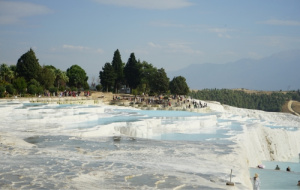 The uniqueness of the Mediterranean world seems to have been shaped from the very beginning — written in its geology. This is where Africa, Europe, and Asia meet, here great tectonic plates collide and fold the earth’s crust into a landscape of striking contrasts: mountains, faults, fjords, and islands all coexisting within the same ea. The Greek islands scattered across the Aegean look like fragments of the crust scattered across the deep blue sea, while Turkey stretches across Asia and Europe, becoming a natural bridge that connects continents as well as cultures. Frequent earthquakes have made local people more aware of the importance of structure and stability, which explains the extensive use of stone, arches and domes. These designs are not only for beauty, but also a response to the power of nature.
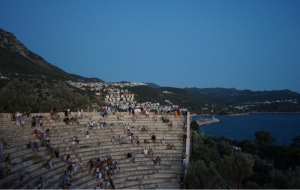 In terms of climate, the Mediterranean is known for its hot, dry summers and mild, wet winters, with sunshine almost all year round. Light and warmth have shaped the “trinity” of olives, grapes and wheat, and also the blue-and-white architecture that defines the region. Natural conditions influence daily life too — people walk slowly under the heat, then gather in the cool evening breeze to talk and share food. Life here is both close to the land and open to the sea — practical yet full of freedom.
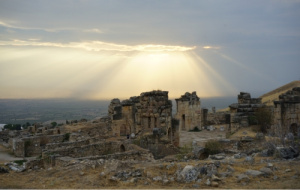 This natural pattern has deeply influenced the spirit of the Mediterranean. The rationality and sense of proportion in ancient Greece grew from people’s sharp observation of light and landscape, while the art of Turkey and the eastern coast reflects layers of cultural exchange between Asia and Europe, full of symbols and patterns. Greek reason and myth, Roman order and power, Byzantine faith and glory, Ottoman elegance and tolerance — all coexist on this sunlit land, forming the layers of Mediterranean history.
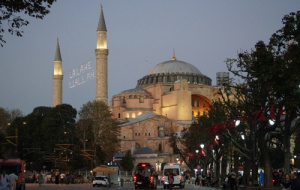 Here, architecture seeks order, sculpture aims for harmony and writing values simplicity and grace. The people themselves share a similar temperament — passionate yet proud, open yet resilient. The Mediterranean is more than a sea; it is a symbol of civilisation. Geography became the origin of culture, climate shaped the outline of spirit, and history, written in light and stone, left humanity’s earliest reflections on beauty and survival. Perhaps that was why, setting foot on this land of light and sea, I felt almost like a pilgrim. From the islands of the Aegean to the valleys of Anatolia, from the ruins of ancient Greece to the spires of Istanbul, I hoped to see and to feel with my own eyes how this meeting place of civilisations continues to move with the rhythm of time.
You can read the full travel diary here.
Published: 1 May 2026
Explore Univ on social media