Fragments of a life
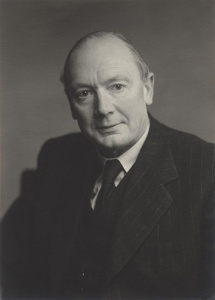
Edmund John Bowen – copyright National Portrait Gallery, London
Professor Jonathan P Bowen FBCS FRSA (Engineering Science, 1974) has kindly shared with the College excerpts from the biographical notes of his grandfather, Edmund John Bowen, a former Honorary Fellow of Univ, written in April 1973.
E J Bowen FRS was “Percy” Fellow and Praelector in Chemistry at Univ from 1922 until his retirement in 1965, and he also served for a period as Domestic Bursar. He is renowned for his pioneering research in photochemistry and fluorescence, as well as for his seminal book The Chemical Aspects of Light. A room at the College is named in his honour.
Part One
These notes were written up in April 1973. As I have never kept a diary and cannot claim a good memory, they are necessarily scrappy, but I hope they are reasonably free from error. My grandfather, John Bowen, when over 70, recorded his reminiscences in a large manuscript book. From it I learned that my great-great grandparents were William and Betty Bowen, buried at Hallow, Worcester; my great-grandparents were William and Mary Bowen. Their son, John Bowen, was born in 1837. His son, my father, was born in 1866 and died in 1929. John Bowen, as I knew him, was a mild, kindly, white-bearded man living at No. 5, Bromyard Road, Worcester. He had retired and was devoted to gardening, giving special attention to his small greenhouse, where he grew splendid grapes. My father, Edmund Riley Bowen, was the eldest of four children. My grandmother had died at the turn of the century, and my grandfather married again, having a second family of two sons. He must have been a marrying man, because, when bed-ridden in his final illness (his second wife having died) he announced his intention of marrying the nurse called in to look after him. This caused great alarm in the family. My father’s sister, saying that he was “a silly old man”, either by persuasion or by some other resolute action, managed to stave off the intention and to save the comparatively small family inheritance.
My mother’s father was Thomas Kamester, a carpenter, of Clever, Windsor. She was one of a large family, and I believe that as a young girl, she started work as a servant at Windsor Castle. Later, when my father met her, she was ladies’ maid to Mr. Isaacs at Boughton Park, St. John’s, Worcester. My father began as an elementary school teacher in Worcester. His stipend when fully qualified was £60 p.a. He had a soft tenor voice and sang in the Cathedral choir. The vicar of St. John in Bedwardine (St. John’s) picked him out for the headmastership of St. John’s Church of England Elementary Boys’ School, with the expectation that he would join the local choir. Between the ages of 20 and 30 my father, as a hobby, constructed in oak a model of St. John’s Church, accurate both inside and out to the finest detail. This is now preserved in the County Museum at Hartlebury, Worcestershire.
Part Two
In 1896 my father married Lilias Kamester and took lodgings in Bromyard Road. Their first child, a daughter, died soon after birth. After I was born, on April 29th 1898, he arranged to buy a house (Avenue Villa, now demolished) in Avenue Road, Bransford Road. The adjoining house was occupied by his brother, Alex Bowen, who had married Rose, my mother’s sister. There was a large garden on light, fertile soil, with several large fruit trees of old-fashioned varieties, red and white currants, gooseberries, and raspberries. A few hens were kept at the bottom of the garden. A large walnut tree, producing the large nuts called “bannuts” stood overshadowing the lane in front of the house.
One of my earliest recollections is of having an ice-bag placed on my forehead during an attack of pneumonia. My parents’ anxiety can be imagined. Perhaps this is why I was definitely spoilt and over-coddled as a child with discernible results in after life.
The family later consisted of myself (Edmund John), Arthur Riley, Violet Lilias, and Vivien Evelyn. The first three of us were somewhat alarmed by the unexpected arrival of Vivien, which soon involved us in duties of pram-pushing and baby-minding. We had a happy childhood playing in the garden and with Alex and Lily, our cousins next door, but we were over-protected from too free acquaintance with children from nearby houses. Social classes were sharply and minutely divided then; the status of a schoolmaster was an awkwardly isolated one. This early conditioning had lasting effects; we were shy with strangers, very inward-looking, and reluctant to show initiative and to assume responsibility. For many years I was terrified at taking part in communal activities such as organised games, expressing opinions in public, etc.
My father’s school was very near where we lived. My schooling began there, and I remember the day I was introduced into Standard I, under the case of Miss Lewis, and set to practise “pot-hooks” as a first writing lesson. I was such a spoilt “mother’s darling” that, in spite of Miss Lewis’ kind efforts, I spent most of the morning most unreasonably crying. Later I was not unhappy at this school, though I never took part in the rough and tumble games the boys played at the mid-morning break.
An old photograph shows my brother and me at the school; we were dressed in a rather namby-pamby manner, differently from the poorer clothes of most of the boys, and felt different, though not superior, to some of the livelier members of the school. We had very few friends there, entirely due to our own faulty outlook.
The old Church of England school (now demolished) was in School Road, Bransford Road. There was a small side room for Standard 1; all the other classes were in the single main room of the school. The headmaster sat at a central desk overlooking all, and also superintended the work of the top class nearby. The teachers stood facing their classes, closely surrounded by other classes. Before I left the school, moveable wooden screens had been introduced to isolate, to some extent, the classes from one another. The classes were very compact because the boys were crowded into long narrow benches which were placed together with no space between, so no one in the class of 40 or more boys was very far from the teacher’s eye.
Part Three
Each teacher had his own method of keeping order; most were confidently mild, but “Tapper” Morton was a disciplinarian who intimidated by cuffs and shakings. Persistent offenders were sent out before the headmaster to receive the “stick”, which without doubt was a salutary influence and regarded as such by the boys. Occasionally the higher classes were treated to lectures; those by the vicar on metaphysical concepts of Christianity were totally incomprehensible, but others were stimulating. One was on the solar system, and in dealing with comets (Halley’s comet appeared in 1910) the lecturer alarmed some by referring to the deadly gas cyanogen occurring in their tails and the possibility of such a tail sweeping over the earth. Another lecturer from a temperance society displayed large coloured charts of “hob-nailed” livers and other vital organs to demonstrate the dangers of consuming alcohol. I remember we were fascinated when he dipped pieces of bread and potato into a solution of iodine to show the presence of starch by the blue colour – one’s first introduction to chemistry. The most interesting break in school routine however was a course of Natural History talks to the top class given by the curator Mr. Edwards at the Worcester Museum. He unlocked the museum case to show us corals, sponges, shells, bones, etc., and spoke in a simple but fascinating manner.
My brother and I were stimulated to begin collecting “museums” of our own. My father had quite a substantial museum at the school containing a great variety of objects – minerals, gold, and silver ores from nineteenth-century American mines, stuffed animals “flexible sandstone”, “landscape marbles”, a mammoth’s tooth, a flint-lock tinder box, etc. His old pupils from time to time presented him with objects dug up in Worcester, such as a battle of Worcester sword. My brother and I became miscellaneous collectors. One day, when we were entering Boughton Park on a newly gravelled path, we noticed a large flint of peculiar shape among the quartzite pebbles. This was identified at the Worcester Museum (where it now is) as a Chellean hand-axe about 30,000 years old. We began to keep an eye open for flints (an alien stone in Worcestershire). In the hop fields of the Teme Valley (where one could walk unseen), on the Worcester Beacon, Ankerdine Hill, and other places, we found a number of Neolithic chipped Flints, scrapers, cores, and one small arrowhead. All were later given to the Worcester Museum. It was an exciting hobby, involving much cycling to the west of Worcester. We used to have summer holidays at farms near Suckley and Woodbury Hill, and another interest was searching old quarries in the narrow Silurian limestone outcrop there for fossils. One summer an exchange visit with a French boy, André Mégissier, was arranged for me which I spent at his home in Tinchebrai, Normandy. I was taken round many interesting trips but was too shy and unenterprising to become fluent in French.
In 1910 I became a day boy at the Worcester Royal Grammar School, to which I walked or cycled twice a day (about seven miles altogether). There was great pressure to take part in school games; with difficulty, I avoided them and chose the alternative of joining the school O.T.C. We drilled and paraded on Saturday afternoons, with occasional field days, and once were taken to a range at Tiddesley Wood to fire a few rounds of .303 rifle ammunition.
Part Four
In form order at school, I was generally top or near it, due more to conscientious study than to a ready ability. The chemistry master, “Tubby” Carter taught in a vigorous manner and imported a sound knowledge of the practical and textbook sides of the subject. The standard of teaching by all the masters was very good, save for “Bertie” Orange, the French master, who struggled in a basement room to control unruly behaviour which the boys seemed to think was the proper thing for “Bertie’s” classes.
In December 1914, at the age of 16.7, I was sent up to try for a science scholarship at Oxford. The First World War had begun, and paper money had just been issued to take the place of gold. I remember that the landlady at the lodgings where I stayed in Walton Street was a little reluctant to accept this new currency. The scholarship examination went well, but the weather was cold, and in the physics practical, which involved stopping up a tube of water many times with the finger, I was alarmed to find that my hands were almost too frozen to write up the results at the end. To everyone’s surprise, I found myself awarded the Brackenbury Natural Science scholarship at Balliol College.
Some knowledge of Greek as well as Latin was then required for Oxford entrance. In my last two terms at school I started this as well as using the privilege of the sixth form for individual study of chemistry. Mathematics was my weakest subject; we had not been taken far into it at school, and I regret to say I never made much further improvement in it. My parents were not well-off; I think my father’s income in 1914 was £300 p.a., or possibly less. Fortunately, my Balliol scholarship of £80 p.a. was supplemented by a Worfield Exhibition of £25 and by one from the Fishmongers’ Company of £50. However, for the next few years, the family budget must have been tight. For some weeks before going up to Oxford in October 1915, to earn a little money, I was taken on by Lewis Clarke, Ltd, the brewers, where my uncle Alex worked as a clerk, as a temporary office boy at 6/- per week. My office tasks were so trifling, though boring, that the firm was not underpaying me.
At last, the time came to go into residence at Balliol College for the Michaelmas Term 1915. Most members of the college had gone off to the war, and an officers’ cadet school was quartered there. The undergraduates consisted of a few Indians and other foreigners, together with medically unfit or under-age persons. The university ran an O.T.C. contingent in which I spent much time. The Balliol science tutor, H.B. Hartley, had already left for military service, and his tutoring was taken over by D.H. Nagel of Trinity College, a kindly old gentleman with a walrus moustache, a wise advisor, not one who insisted on regular hard work. The main laboratory at Balliol behind the Hall, was freely open for practical work; the uncrowded conditions of the time made working there pleasant.
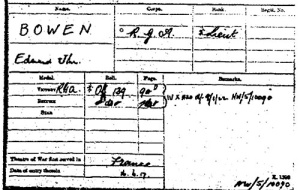 At the end of 1916, though conscription had not yet been brought in, I felt that I ought to join up, so I volunteered for army service. I was selected for training as an artillery officer and sent to Maresfield Camp, Sussex. War casualties had been so great that there was a severe shortage of gunners, and we were put through a crash course, ending with a ridiculously simple examination. We were allowed to take Training Manuals in (or at least, no one objected), so as to copy any answers, and the day before one of the instructors had said “If you should get a question tomorrow on how to service the buffer and recuperator of the 6″ howitzer, this is what you should say…”. We wrote it down, and, sure enough, there was the question the next day. Everyone in the course passed, except for two reprobates who got so drunk the night before that they failed to turn up for the examination.
Part Five
We were then sent to Lydd to see a gun for the first time and to observe some firing, and were soon dispatched to France as “fully trained officers” – in fact totally inexperienced in handling a battery. I found myself attached to No. 13 Siege Battery, R.G.A., a battery of 9.2 in. howitzers, firing shells of 290 lbs., and chiefly used for counter-battery work. Maximum range was 10,000 yards; usual ranges were 6,000 to 8,000 yards. To reach enemy batteries, the guns were always situated well up to the front. The battery was commanded by Major Collins, who received me with the words “We all drink whisky here; I hope you do”. Till then I had never drunk anything alcoholic, but I took the glass of whisky and pretended to look mature. The guns were then behind the “Spoil Bank” of the canal to the east of Ypres. The operational quarters were in a trench roofed over with sandbags; a small deep dug-out nearby was used for sleeping in. Spare battery stores and the tractors were kept a mile or two in the rear at the ruined village of Dickebusch.
Shelling by both sides was very active at the time. Fighting had been going on and continued for several months on the Ypres sector. I had not joined the battery for more than a few days before a shell killed Major Collins and wounded some other officers. By luck, I happened at the time to be on duty at Dickebusch. Not long afterwards, there were other casualties, and the battery was left for a few days with only two officers, until replacements were sent from headquarters.
The Hill 60 mine craters were not far away from the battery position and during a quiet period I walked over to see them – enormous holes in a battlefield of mud, shell craters, barbed wire, and abandoned equipment. The 9.2 in. howitzer was a heavy, unwieldy weapon, ill-designed for use in the muddy conditions of northern France and Belgium. The barrel, mounting, and steel foundation beams were dragged to a site on trailers drawn by a “caterpillar”. First, the three heavy foundation beams had to be set down, the mounting fixed on these, and the barrel pulled into place and connected up. Finally, a large steel box at the front had to be filled with earth to give extra weight. Once mounted, a gun could only be traversed over limited angles right and left. Its central line was determined by theodolite from a map direction making a measured angle with an aiming point set up to the rear or side. The target, of course, was never visible from the gun site. When the battery was notified of a target by headquarters the angular direction was read off from the map, and also the range. Rapid calculations were then made of the angle to which the gun’s dial-sight should be set to fix on the picket or other aiming point, and also of the required elevation. Corrections were required for wind, where velocity had to be resolved into magnitudes along and across the line of fire; smaller corrections were supposed to be made for temperature and for weight of shell since the latter varied somewhat in different batches.
Part Six
Shells were lifted by a small crane to the breach of the horizontal barrel, rammed in by two men, the cordite charge in its fabric bag inserted, the breach closed, a friction-operated firing plug with lanyard put in place, and the barrel given its required elevation and traverse. The 290 lb. shells, with instantaneous or delay action fuzes, were capable of doing considerable damage to enemy batteries, trenches, or dugouts.
The shells stored for use near each gun were not fitted with fuzes until just before loading. On one occasion some unfuzed shells received a direct hit by an enemy 150 mm shell. They did not blow up; one had its thick steel casing broken open and the area was stained by the yellow picric acid scattered about.
Battery officers took it in turn to man O.P.s (Observation Posts). These were in some forward position with a view of enemy targets, either in a trench or in some small roofed-in construction. They were connected to the battery by telephone wire, run temporarily across country, and kept repaired from breaks by signallers patrolling the line. From O.P.s, a general watch on enemy activity was kept, and, when required, fire from the battery could be “ranged” on a target. As a newcomer, I at first did not appreciate the sharp eyes of the enemy and the need to keep as well hidden as possible. On one occasion, in a recently captured German trench, my signallers and I were the recipients of well-directed heavy shelling, which we were lucky to escape from, as the refuge provided by the trench and a nearby concrete “pillbox” were not good protection from fire coming in the opposite direction for which they had been built. Heavy fighting continued through the autumn of 1917 on the Ypres Salient, and small gains of ground were made with many casualties and terrible conditions for the infantry with mud and water-logged trenches.
13 Siege Battery was ordered up to the notorious Sanctuary Wood. The area was one of deep shell holes with practically no gaps in between. Most of the holes were full of stinking water, on which floated debris better not examined too closely. The sharp arêtes of loose muddy earth between the craters were dangerous; anyone slipping in would be unlikely to escape drowning, so steep and crumbling were the sides. The smell of unburied dead and of high explosive was everywhere. A “corduroy” road of plants had been made which enabled the guns to be brought in, but their mounting was difficult. The shocks of firing caused the foundation beams to sit and the guns to tilt, requiring much hard work to put right. In planning their activities, the higher military authorities seemed to make no allowances for the infantry and other services to avoid the consequences of the abnormally wet autumn and the churned-up impermeable sticky clay soil of the region.
With the battery at Sanctuary Wood and the infantry struggling to gain ground ahead, an O.P. was needed beyond the ridge in front to overlook Nonne Bosschen Wood and beyond. I was sent out with a corporal and two signallers. Beyond the ridge, there was a clear view for miles over German-held territory. We went on, passing a few soldiers in odd bits of trench. The troops of both sides kept as concealed as possible, and there seemed no way of telling, in the open order attack, how far our lines extended and where the enemy’s began.
Part Seven
We picked on an empty trench for an O.P. The Germans could not have been far ahead. Someone spotted our movements in the trench and turned on a field-gun battery. Suddenly there was a deafening explosion; the trench wall caved in, and we were half-buried in soil. As I was falling back, while the ground tumbled in, I had a momentary glimpse of the corporal beside me. A shell splinter had smashed a hole through his head, and he fell forward and was partly buried at my feet. When I recovered from the shock, I could see that the shell had exploded on the trench parapet only a yard or so away. I received nothing more than a small cut in the thigh and some tiny metal particles just penetrating the skin.
Two other incidents of that autumn I remember. The battery major and I went forward one day to the ruined farm of La Chapelle to judge its suitability as a gun site. We were caught by some well-directed shelling, and threw ourselves down flat. Splinters flew all round, but the only thing that came my way was a shovel blown through the air, and was a near miss. The other incident was in Sanctuary Wood, where the gun crews were crouching without real cover among the shell holes while subjected to heavy fire. My “tin-hat” was suddenly struck off as if someone had hit it with a crowbar. Several men were wounded, and one was blown into the mud of a deep shell hole. He was got out with difficulty but was too badly injured to survive.
In November 1917 the battery moved south to take part in an attack on which great hopes were placed. We were sited on the rear outskirts of Gouzeaucourt. For days, and concealed by foggy weather, the roads had been congested with masses of artillery and stores moving up into position. There were numbers of Whippet tanks, motorcycles with machine guns mounted in sidecars, and even a cavalry regiment ready for the hoped-for breakthrough into back areas. Long before dawn on the appointed day (after a pretty sleepless night) I was on my way as O.P. officer, joined by a young lieutenant from another battery. We found a somewhat exposed post in a small trench, Shelling was heavy throughout the day, and machine-gun bullets made the place very unpleasant. My companion, who had moved a little away, was killed by one of the bullets. Late in the afternoon, it became apparent that the attack had not gained much ground – in fact, it was really a failure.
During the next ten days or so there was a lull. Two episodes I remember. One was being caught in the open by shrapnel; the shells were bursting in the air with puffs of black smoke, followed by a savage rain of shot on the ground all around – no hits, fortunately. The second was while I was wandering about the area, looking over the devasted state of the ground over which fighting had taken place, when shelling started. A shell burst about 200 yards away behind me, to the right, and as I turned round, I could see a splinter coming straight towards me. There was no time to move; it was travelling fast, and I could see it only because I was looking almost exactly on its line of flight. The splinter cut across the back of my trench coat making a jagged tear without leaving any mark on myself.
Part Eight
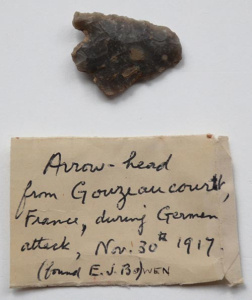 It was believed that the infantry who had recently attacked had not been relieved or reinforced, and the lull, above mentioned, was unexpectedly broken by a counterattack. The British front lines seem to have been completely over-run, because, with no notice, early in the morning, we suddenly realised that German infantry were arriving and manning the rising ground on our right. Our guns could not point so far round in that direction. We could not assume an infantry role – our few rifles were stored in part of the village already being occupied by the enemy. There was nothing to do but hastily to put the guns out of action by damaging the breach blocks and to go. While running down a sandy lane (Dead Man’s Lane on the map) I picked up a nice flint arrowhead (but not a useful weapon at the time!) The battery personnel regrouped at the base at Fins. It was not long before a British counterattack regained the lost ground. Near the battery position, we found that abandoned stores of rum, intended for those in the line before the counterattack, had been locked and several men had drunk themselves to death. (Army rum was a very strong, potent, fiery liquid, issues of which were later supplemented by very concentrated unsweetened lime juice.) Our guns being unusable, we enjoyed a period away from the front and later received six new guns of improved pattern to replace the original four.
The beginning of 1918 was a period of heavy shelling with a good deal of gas shell. Wearing of respirators for lengthy periods was not very pleasant. The battery moved up to Havrincourt Wood to help in an attempt to take Cambrai. In March rumours spread that the Germans were preparing a powerful attack themselves. They were only too true; the British lines were penetrated and the whole Fifth Army was forced to retreat for miles. There was just time to demount the battery and to drag it away by its tractors but owing to a shortage of lorries some stores and kit had to be abandoned. I was sent to a forward position with a lorry to collect things left there, the most valued article being the gramophone and records. We were lucky to get back; all British troops had already gone; the road was clear, and the Germans were evidently soon to arrive. We did not linger on the way, later joining the congestion of retreating vehicles. The battery was well to the rear of the mass of traffic, owing to the time needed to get the guns away, so I was able to catch up with it fairly soon. The Germans advanced cautiously, and we were not harassed while retreating. Fortunately, the Third Army, on the left of the Fifth, was able to put up a better resistance, but the situation was critical, as available reserve manpower was insufficient to close the gaps made in the line. The battery fell back through the whole of the Somme area until the line stabilised behind Albert. On this front, both sides suffered heavy casualties and worked themselves into an exhausted state. The Germans during the next few months transferred their attacks elsewhere and violent fighting continued until July. With the arrival of American troops, the balance began to turn in favour of the Allies.
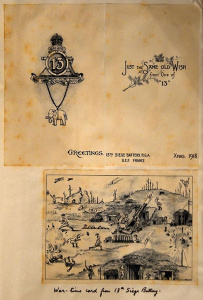
EJ Bowen’s WWI Christmas Card 1918
During August the battery followed up back across the Somme area, retracing more or less its line of retreat five months earlier. Heavy fighting continued on several fronts during August and September, but soon the Germans were retreating too fast for 13 Siege battery to keep up with them. When the signal indicating the end of the War was received on November 11th we were a good way from the moving front. We celebrated with beer, and for the first time produced our Webley revolvers and used up our ammunition on beer-bottle targets.
Part Nine
For most of the troops, demobilization was to take months, and units had great difficulties in handling insubordination by frustrated men. Coalminers and students, however, came in the top category for early release, and I was able to become a civilian again in time for the Oxford Hilary Term 1919, having been away for exactly six terms. Five terms later, in June 1920, I took the Final Honour School of Chemistry and managed to obtain a First Class. The chemistry tutor at University College, R.B. Bourdillon, had decided to take up medical studies, and to fill the vacancy I was soon appointed “Percy” Fellow of the college. There were then only eight Fellows; the Master was Dr. Macan, just about to retire. Sir Michael Sadler was elected in his place. My Fellowship started at £300 p.a., and in addition, I acted as a demonstrator in the Balliol and Trinity Laboratories, where a practical physical chemistry course was available to undergraduates from all colleges, my stipend being £150 p.a.
At this period my mother became ill with breast cancer. X-ray treatment at Birmingham was ineffective, and she died after a few months. It was a great blow to my father. He had to employ a widow as housekeeper; later they were married, whereupon the new wife assumed imaginary invalidism (she ultimately lived to be 80), and my father shouldered most of the domestic chores. After recovering from a mild stroke, he died from a second in 1929. A friend of mine at the Royal Grammar School was William Young, whose father was the village schoolmaster at Sytchampton, some miles north of Worcester. Though him I became acquainted with the Moule family, farmers at Hartlebury. The eldest daughter of Joseph and Margaret Moule, of Skeys Farm, was Edith. We were married in July 1924, each to be introduced to new environments, she to the academic world and I to that of farming. How often in later years did I enjoy the privilege of joining in rabbit, partridge and pheasant shooting, when the company would walk all day through fields of sugar beet, sprouts, stubble or woods belonging to farms over a wide area, with a substantial dinner and country talk in the evening.
After graduating in 1920 I spent a holiday in the Dolomites, walking in the Alps below the Rosengarten and the Sella group. The Oxford Mountaineering Club was being resuscitated, and I did some climbing with other members in North Wales, the Lake District, at Zermatt, and in the Chamonix district. In July and August 1924, after getting married, Edith and I first took a holiday in the Lake District and then went on to Zermatt where some members of the Mountaineering Club were staying. I managed a few climbs; Edith was reluctantly persuaded to ascend the Riffelhorn. The following Easter we joined some friends in the Lake District, ascending Great Gable, Great End (by Cust’s Gully), and some other heights. However, an accident occurred which was serious for Edith. We were crossing the col covered with hard frozen snow just before the final rise to the summit of Scafell Pike, when Edith slipped. I dashed across just below her but was bowled over, and we both started sliding down the gully. We had some bumps going over pieces of rock sticking out. I managed to slow us up by using the ice-axe, and Kenneth Leys, a colleague at Univ., ran across the slope and helped us to get up.
Part Ten
Later it became clear that Edith was going to lose the baby due to be born later in the year. She had to go into hospital at Birmingham. It was before the days of penicillin; there was some infection, and she had a very unpleasant time. Fortunately, all went well in the end, but it was a worrying affair, and one which put her off further visits to the mountains.
We lived at 15 Banbury Road, a house belonging to the college. Margaret was born on June 28th 1927. Later that day I drove a senior colleague Dr. Farquharson to Dr. Dawkins’ house in North Wales to see the total eclipse of the sun due on June 29th. However, the next morning was overcast with rain. All we saw was the dark moon shadow racing towards us over the sea, and the sudden darkness, lighting up rapidly after a minute or so. Only observers at Giggleswick had fleeting glimpses of the sun during totality.
Humphry was born on June 22nd 1929. Soon afterwards we moved to the freehold house No. 10 Park Town, somehow finding the sum of £2,600 to purchase it.
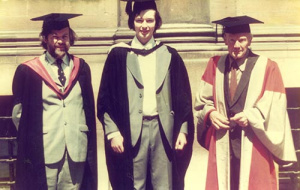
Three generations – Humphry, Jonathan and E J Bowen in academic dress at Oxford in 1977
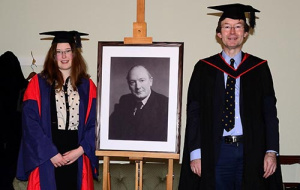
Professor Jonathan and Dr Alice Bowen (2008, Chemistry) with the portrait of E J Bowen in the Bowen Room at Univ in 2013
This feature was adapted from one first published in Issue 18 of The Martlet; read the full magazine here or explore our back catalogue of Martlets below:





Explore Univ on social media