Univ Physicists lead advance in laser science

Dr Robin Timmis and Professor Peter Norreys
Dr Robin Timmis (2020, DPhil Atomic and Laser Physics) and Professor Peter Norreys, Univ’s Supernumerary Fellow in Physics and Professor of Inertial Fusion Science, have unlocked a new route to extreme light intensities, reporting their findings in a study titled “Efficiency-optimized relativistic plasma harmonics for extreme fields”, which was published in Nature.
The study also involved three current Univ students, Heath Martin (2018, DPhil Computational Discovery), Rusko Ruskov (2018, DPhil Atomic and Laser Physics) and Eduard Atonga (2015, DPhil Atomic and Laser Physics) and the team collaborated with scientists at Queen’s University Belfast and the Science and Technology Facilities Council’s Central Laser Facility (CLF). The work also involved broader international collaboration, including researchers from AWE plc, the University of Michigan and the University of Jena in Germany.
During their research, the team created extremely bright ultraviolet light through an unusual approach, which involved firing an intense laser at a cloud of charged particles (a plasma), causing it to behave like a rapidly moving mirror. The fast moving “mirror” brings into play Einstein’s theory of relativity, as the light is boosted to much higher energies. The effect is known as relativistic harmonic generation, and the team were also able to further concentrate the light in what is known as a coherent harmonic focus, creating an enormous concentration of energy.
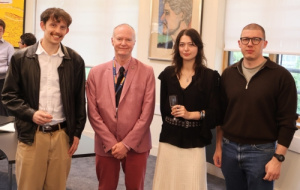
Heath Martin, Professor Peter Norreys, Dr Robin Timmis and Rusko Ruskov
The findings are significant to the scientific community as they could, in time, allow scientists to further explore how light and matter interact. The extreme conditions that can be recreated as a result of this study offer the potential to test both long-standing theories about the nature of the universe and our understanding of quantum field theory in regimes that have not previously been explored. To celebrate the publication of the article in Nature and mark the team’s successful collaboration and academic achievement, Professor Norreys hosted an afternoon tea in the Butler Room at Univ.
Lead Author Dr Robin Timmis, who won this year’s Culham Thesis Prize for her work on laser plasma surface interactions, said, “The discoveries we have made so far are fascinating and it feels like we are just getting started in terms of understanding the rich and complex physics of this mechanism. The simulations suggest that we may have made the most intense source of coherent light ever.”
Senior Author Professor Norreys, said, “We are excited to have realised this extraordinary result in the laboratory. It is a testament to Robin’s exquisite mastery of the subject for her to have obtained the precise experimental conditions that have eluded us for decades.” Professor Norreys was also recently awarded the prestigious Société Française de Physique and Institute of Physics Holweck Prize.
Published: 26 June 2026
Explore Univ on social media