Fluid Dynamics at VKI in Belgium
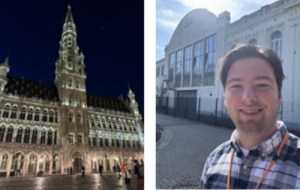 Graduate Research Training Fund report – Maximilian Farfaras (2023, Future Propulsion and Power)
In early March, I travelled to the von Karman Institute for Fluid Dynamics (VKI), located between Brussels and Waterloo in Belgium. The VKI was founded in 1956 by Dr Theodore von Karman, arguably one of the greatest aeronautical scientists of the twentieth century. He founded North Atlantic Treaty Organization’s (NATO) Advisory Group for Aerospace Research and Development (AGARD), and the Defence Research Group (DRG) after convincing NATO members of the importance of staying ahead in the aeronautical sciences. The primary building began as a lab under the Belgian Ministry of Defence but was converted to the VKI with the aim of sharing knowledge, training, and furthering aerodynamic research topics amongst NATO nations.
The week covered topics related to boundary layer stability and transition. A boundary layer is formed when a viscous fluid interacts with a surface. Near the surface, the fluid molecules stick to it and stop moving, but as you move further away, the fluid speeds up until it reaches the bulk velocity of the fluid. The boundary layer is a key feature of fluid flow that has significant performance implications, despite its thin size. For example, it impacts aerodynamic drag, heat transfer between the fluid and the surface, and flow separation – where if the boundary layer loses energy, it may peel away from the surface, causing stalls in aerofoils.
Depending on several factors but primarily captured the ratio of inertial forces to viscous forces (described by the Reynolds number), the fluid, including the boundary layer, may be laminar or turbulent. Laminar boundary layers reduce skin-friction drag and heat transfer, however, are prone to flow separation. The opposite is true for turbulent boundary layers. While we can account for these scenarios through good engineering, the point where the boundary layer transitions from laminar to turbulent (or back via reverse transition), is a topic of significant research efforts due to the challenging nature of predicting the onset of transition, which we wish to due accurately to balance the benefits of both laminar and turbulent flow. The accurate prediction of separation is also challenging and highly desired to extract maximum performance.
Several transition mechanisms impact flow instability, which are necessary to understand for a wide range of applications, including hypersonic spacecraft, detached flows in aero-engines, aeroacoustic interactions, and drag reductions in air vehicles. At VKI, we discussed these mechanisms, including analytical and numerical methods to analyse them through linear and non-linear stability theory, transient growth, and resolvent analysis. The use of machine learning to produce a more accurate efficient model and experimental techniques were also covered. Speakers included worldwide experts from NASA Langley Research Center, DLR (German Aerospace Centre), the European Space Agency, ANSYS, ONERA (French Aerospace and Defence Lab), VKI, and several universities. The week also featured tours of VKI facilities and networking events.
For my research, topics on boundary layer transition and stability with applications to turbomachinery were of key interest, where I plan to use the knowledge to support the development of high-lift turbine blades for future aircraft jet engines in collaboration with Rolls Royce.
We also took the opportunity to explore central Brussels and Bruges, both of which were lovely!
Read the full report with diagrams here.
Published: 19 June 2026
Explore Univ on social media