The Silken Rowers of 1903
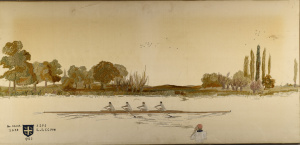
UC Boat Club Embroidery
To celebrate Eights Week 2026, we report on a remarkable new arrival in the College which commemorates a rowing crew from 1903, but is quite unlike anything else which Univ has ever received.
In September 2025, the Men’s Vice-Captain of Boats, Sebastian Collins, received an unexpected message from a framer’s firm in Suffolk. They were offering for sale a piece of silk embroidery which appeared to depict a crew from Univ from 1903. The case was taken up by Nick Kanellakis, our Lecturer in Pathology, and a Senior Member of the Boat Club. Thanks to Nick’s agency, it proved possible to purchase the embroidery, which came already framed.
Because of its fragile state, it was agreed that it would be unwise to hang the embroidery in the College Boathouse. Instead, therefore, a facsimile was made of the piece and installed in the frame, and this can now be enjoyed in the Boathouse. Meanwhile, the original embroidery was repaired by Shannon Cherry, a specialist textile conservator, and this now lives in the College archives, where arrangements can be made to view it. It has the reference UC:O4/X8/1.
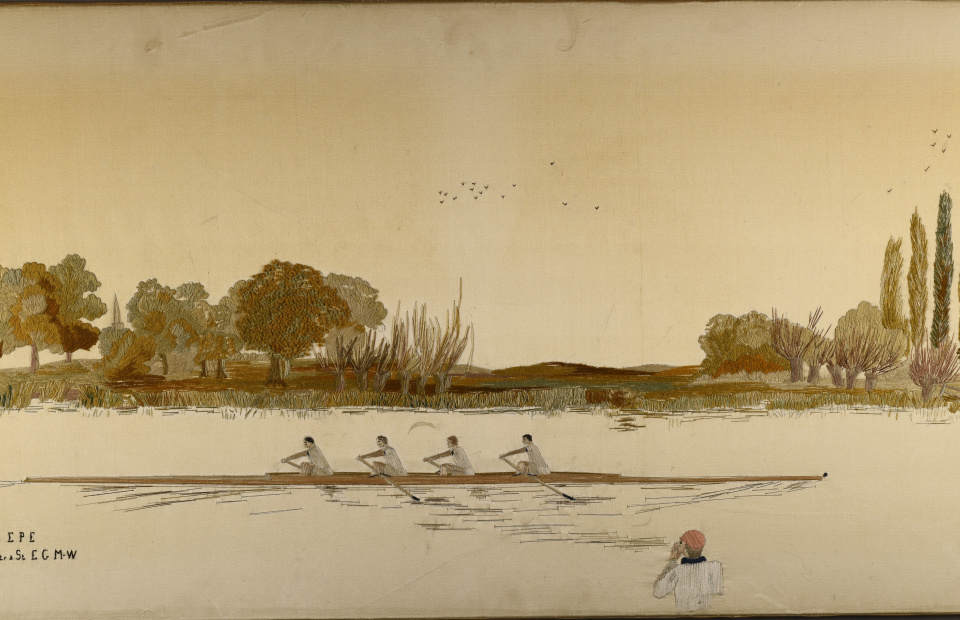
The embroidery is a substantial piece, measuring 930 by 450 mm (36 by 18 inches). As you can see, it shows a coxless four rowing (presumably on the Isis) with someone on the bank (a coach?) evidently calling out to them. The leaves in the trees suggest that they were rowing during the summer.
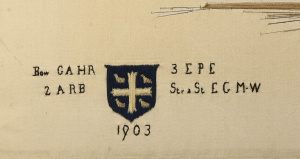
UC Boat Club Embroidery (for a larger photograph, go to the bottom of this page)
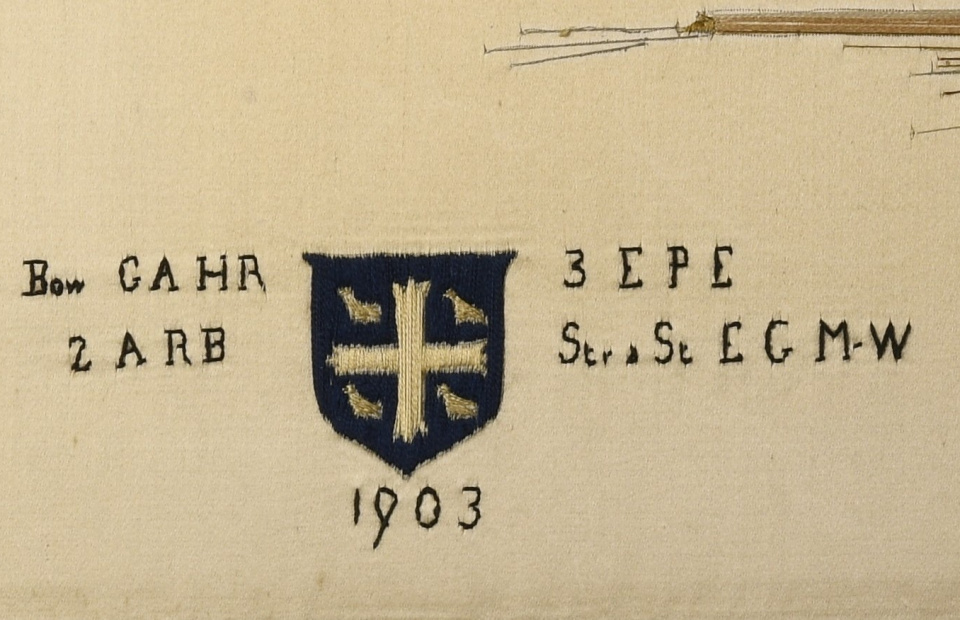
In the bottom left-hand corner of the embroidery the artist has stitched in the College coat of arms, the date (1903) and the initials – and places in the boat – of the four rowers.
This embroidery was created during a great period for Univ rowing: in 1902 we went Head of the River, and from 1900-4 were never out of the top four in Eights Week. Meanwhile, in Torpids, we came second every year between 1901 and 1904, and went Head in both 1905 and 1906. We also won the Ladies Plate at Henley in 1901, one of the most important races in that regatta.
Meanwhile, thanks to our student records of the time, it has proved possible to identify all four members of the crew, and to find out something about their later lives.
At Bow sat Gerard Arthur Holland Robinson. He was the only son of Arthur Holland Robinson of London and came up from Radley as a Commoner in Michaelmas Term 1902 aged 18. He planned to read History. It seems, however, that he wasn’t of a very academic turn of mind, because by October 1904 he had switched from History to the less demanding Pass School, which tested him on more general subjects. He did at least pass that, because he got a BA in 1905.
During the First Word War, Robinson served as a Captain in the 4th Oxford and Buckinghamshire Light Infantry, and became Assistant Inspector of the Quarter-Master-General’s Services. In later life, he became a wine merchant for Messrs H. B. Fearon, Block, and Co., and he died on 12 August 1949.
Second in the boat sat Archibald Roxburgh Balfour. He was the fourth son of Alexander Balfour of Liverpool, Lancs., and he came up as a Commoner in Michaelmas Term 1901 aged 18, having been educated at Edinburgh Academy. Balfour was a very keen rower: he was a member of the First Eight which went Head of the River in 1902, and he rowed in the Oxford Boat in 1904 and 1905. He also served as JCR President in 1903/4. With all these exciting distractions, it is perhaps not so very surprising that, although he did sit for an Honours Degree in History in 1904, he only got a Fourth.
The quality of his degree did not matter greatly, because, as his obituary in the University College Record of 1958 reports, he went straight into the family business, Balfour, Williamson & Co. This was a trading and shipping company largely based in Chile, with extensive links with Peru, and Balfour therefore went straight out to South America after graduating. In 1914, he returned to England to join up for the First World War, when he served in France and Salonika, and was awarded in the Military Cross. After the war, he returned to Chile, before moving to Peru in 1927. He became the Director of several many companies there, including the National Telephone Company. He was also a keen polo player. After this long and adventurous life, he died on 21 August 1958.
The third member of the crew was Edward Pritchard Evans. He was the oldest son of Edward Muirhead Evans of Ilkeston, Derbs., a clergyman, and he came up as a Commoner in Michaelmas Term 1902 aged 19. Like Robinson, he had been at Radley. Once again, he also read History, but he managed a Third in his Finals in 1906. Like Balfour, he took his rowing seriously because he was also a member of the Blues Boats of 1904 and 1905 – as well as that of 1906.
After leaving Univ, however, Evans disappears from view. We know nothing about his later career; he does not even feature in the great Roll of Honour compiled after 1918 to record which Oxonians served in the First World War. All we have is a note by his entry in our Admissions Register that he died in September 1942.
The crew’s stroke, who also steered the boat, was Evelyn Grantham Monier-Williams. He was the second son of Monier Faithfull Monier-Williams of Chessington, Surrey, and came up in Michaelmas Term 1900 aged 18. He had been to Winchester. Several members of the Monier-Williams family have been at Univ. over the years, including Evelyn’s grandfather, two of his brothers, and some of his nephews. Evelyn read Law, and got a Third in Trinity Term 1904. He was the third member of this Four to win a Blue, in his case doing so in 1903. Like Balfour, he was a member of the Univ crew which went Head of the River in 1902.
We have seen that Robinson, Balfour and Evans all lived for decent lifespans. Sadly, the same was not true for Monier-Williams. The University College Record for 1908/9 reported that “Two comparatively young and specially promising members of the College in the Colonial Service fell victims to African fever, on the threshold of what promised to be brilliant careers: Evelyn Grantham Monier-Williams, B.A., and Henry Hugh Baker, MA.”
A few years ago, the Archivist was contacted by a researcher who had visited the Anglican Memorial Cathedral at Mombasa, Kenya, which had been consecrated in 1905. There he found a plaque dedicated to E.G. Monier-Williams “from four fellow members of University College Oxford”. Sadly, he didn’t provide a photo.
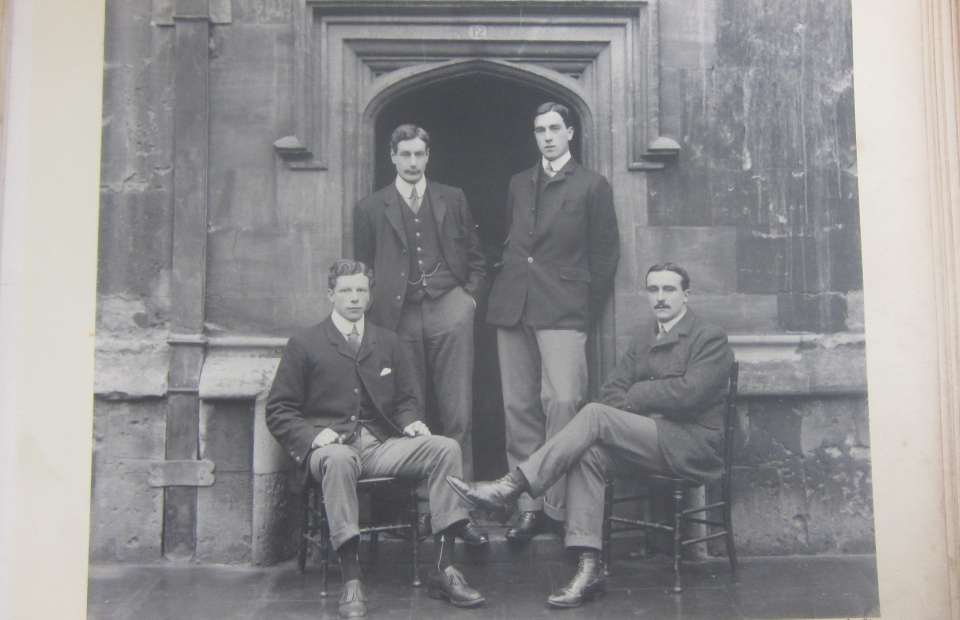
We know the names of the 1903 Four, and we know about their academic careers and the later lives of three of them. Best of all, we also know what they looked like. The UCBC photograph album for 1901-8 (ref UC:O4/P1/3) includes a photograph of the Four of 1903, and here they are:
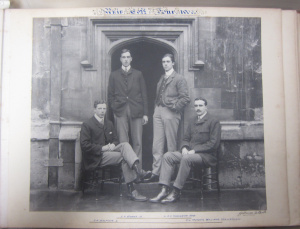
Fours 1903
From left to right, we see Balfour, Evans, Robinson and Monier-Williams. A note in the album next to the photograph says that, in the OUBC Fours that year, this crew got to the third heat, but lost to Balliol.
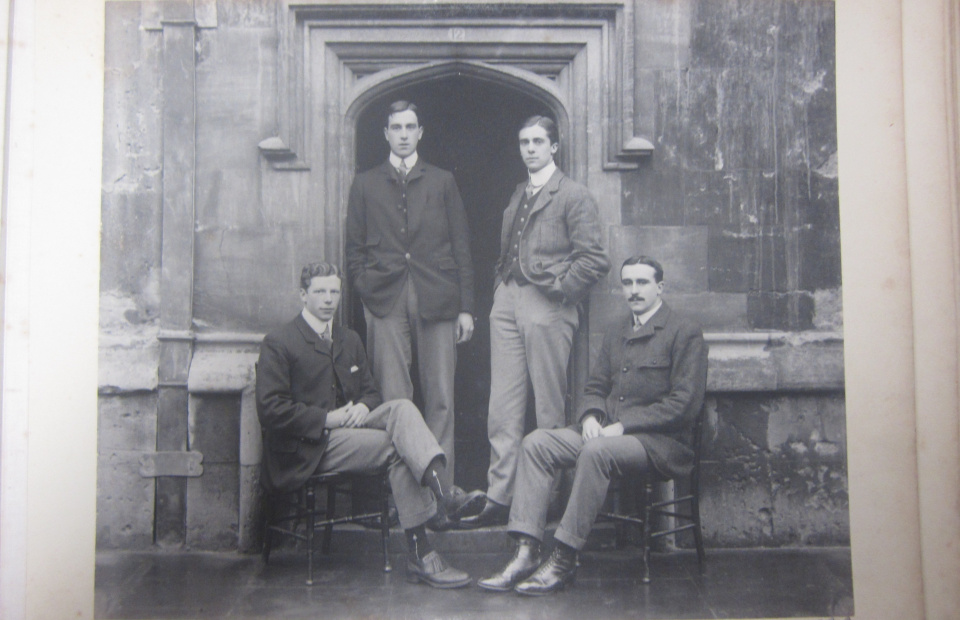
Three members of this Four, however, redeemed themselves later in 1903, when they rowed at Henley, and won the Visitors’ Cup. Here is a photograph of that crew:
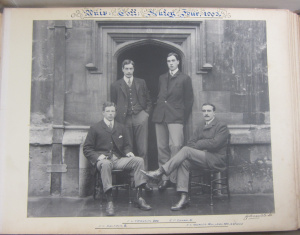
1903 Henley IV
Balfour, Evans, and Monier-Williams are still here, but Robinson has been replaced at Bow by Claud Geoffrey Pearson, the third son of Charles John Pearson of Edinburgh, Scotland. He came up in Michaelmas Term 1900, having been educated at Fettes. Pearson read Classics, getting a Fourth in Mods in 1902. There is no record of his getting an Honours Degree. Pearson was a third member of the Head of the River Crew in 1902. In the light of Pearson’s grander rowing career, one wonders whether Robinson might have been a substitute for him in the OUBC Fours race – but Pearson was able to appear in time for Henley. Sadly, like Monier-Williams, Pearson did not have a long life. His death was reported, with no details given, in the University College Record of 1911/12.
This, then, is the story of the College’s remarkable new acquisition. There does, however, remain one mystery. The embroidery is unsigned, and nothing is known of its authorship. The likeliest theory is that it was produced by a female relative of one of the rowers. An Edwardian young lady would have been expected to learn appropriate “accomplishments”, so that she would have had the skill to create such a piece of embroidery.
The Archivist thanks Sebastian, Nick and Shannon for all their help both in arranging for the acquisition of the embroidery, and for conserving it for future generations.
Larger images of all the photographs can be seen below: