
The Ballad of Reading Gaol
 Born in Dublin in 1854, Oscar Wilde has become a literary giant, known for his prose, plays, poems and general wit. Aside from this, however, he is also notorious for the civil libel case he was involved in and the criminal case against him for homosexuality. In this Treasures series we have previously looked at the pamphlet detailing the contents of Wilde’s house when it was put up for auction while he was in prison awaiting trial. You can find the article here.
We have also looked at translations of his work The Happy Prince, found here. This time we will be looking at Wilde’s writing while in exile in France after his release from prison, specifically The Ballad of Reading Gaol.
Wilde’s downfall came due to his relationship with Lord Alfred Douglas. Douglas’ father, the Marquess of Queensberry, accused Wilde of being a sodomite and Wilde sued the Marquess for criminal libel. This case went to trial in April 1895 and the evidence quickly stacked up against Wilde. He dropped the suit, but the evidence provided in court left him open to being arrested for homosexuality, then a crime in England. In May 1895 he was found guilty and sentenced to two years at hard labour. The majority of this was served at Reading Gaol.
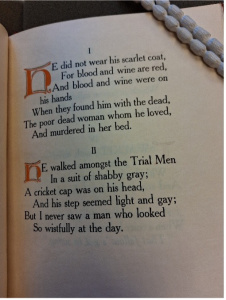
Figure 1: The Ballad of Reading Gaol (1905)
At Reading Gaol Wilde spent much of his time in solitary confinement. Part of his punishment consisted of walking on a treadmill for six hours a day. He was only allowed two books a week, which he read repeatedly. After an appeal to the Home Secretary for early release, he was allowed more (but denied the early release) and read in English, French, Italian and German. He was released from prison in May 1897 and immediately left England for France. It was there that he would write The Ballad of Reading Gaol.
This long poem deals with a prisoner being executed for murder and muses on themes such as love, death and life in prison. It ends with the famous stanza:
‘And all men kill the thing they love,
By all let this be heard,
Some do it with a bitter look,
Some with a flattering word,
The coward does it with a kiss,
The brave man with a sword.’
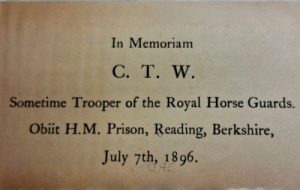
Section V of the poem deals with conditions in prison, talking about the ‘brackish water that we drink/ Creeps with a loathsome slime’ and how the ‘bitter bread they weigh in scales/ Is full of chalk and lime’. The hopelessness that he must have felt in prison is shown in the lines ‘And by all forgot, we rot and rot,/ With soul and body marred.’. The Ballad of Reading Gaol gives a glimpse into how prison impacted Wilde. In the 1898 edition of The Ballad of Reading Gaol in the collection, there is a dedication to the inmate who was executed. His name was Charles Thomas Wooldridge who had been a Trooper in the Royal Horse Guard before being imprisoned for the murder of his wife.
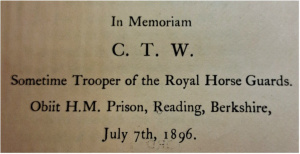
Figure 2: The Ballad of Reading Gaol (1898)
The Robert Ross Memorial Collection contains multiple editions of The Ballad of Reading Gaol, dating from 1898. There are also various translations, including the Spanish Balada de carcel de Reading (1898), Ballade de la geòle de Reading (1898) in French, the Italian La ballata della prigione de Reading (1907) and the German Die Ballade vom Zuchthause zu Reading (1903) among others. There are also some beautifully illustrated copies, including a 1927 French copy illustrated by Jean-Georges Cornélius.
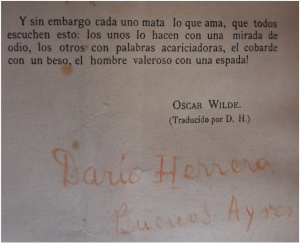
Figure 3: Balada de carcel de Reading final stanza
Some of these editions proved difficult to get hold of. In the ephemera that belongs to the Robert Ross Memorial Collection, we have letters detailing Ledger’s hunt for Balada de carcel de Reading. One of the letters is dated 17th February 1909 and is from the British Vice Consul in Buenos Aires, in which he says that they cannot find the periodical and translation that Ledger is looking for. The periodical was called El Mercurio de America and the translator was Dario Herrera. Ledger was able to get a hold of this copy, as seen in this photograph of the final stanza of the poem.
This copy of Balada de carcel de Reading that is in the Robert Ross collection is
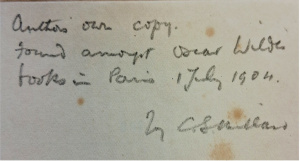
Figure 4: Balada de carcel de Reading inscription
actually Oscar Wilde’s own copy of this translation with an inscription inside reading ‘Author’s own copy. Found amongst Oscar Wilde books in Paris 1 July 1904’. This note comes from Christopher Millard, who was Wilde’s bibliographer.
The examples given above are just some of the translated editions of The Ballad of Reading Gaol held in the Robert Ross Memorial Collection. The fact that so many exist shows the international appreciation for and appeal of Oscar Wilde’s work. Within the wider collection, there are many translated works of Wilde’s. You can see this in the 1932 handlist detailing the collection that is available on the Library’s Special Collections page on the Univ website.
Interestingly, Reading Gaol has been at the centre of some dispute recently. It was bought two years ago by a businessman who hopes to turn it into a hotel, museum and art gallery. There has, however, as of January 2026 been no planning application made. Currently the buildings are empty, and the public will have to just wait and see what this landmark in Wilde’s life is turned into.
References and further reading
Beckson, K. & Ostberg, R. (2026) Oscar Wilde. https://www.britannica.com/biography/Oscar-Wilde (Accessed: January 30, 2026).
The Ballad of Reading Gaol (no date). https://www.poetryfoundation.org/poems/45495/the-ballad-of-reading-gaol (Accessed: January 30, 2026).
O’Hagan, P. (2026) What’s happening with the plans for historic Reading Prison? https://www.bbc.co.uk/news/articles/c74v9y2mrmjo (Accessed: January 30 2026).
Rumens, C. (2022) ‘Poem of the week: The Ballad of Reading Gaol,’ The Guardian, 13 October. https://www.theguardian.com/books/booksblog/2009/mar/23/oscar-wilde-ballad-reading-gaol-poem (Accessed: February 04, 2026).
Wiltshire, T. (2025) Oscar Wilde in prison. https://www.mansfield.ox.ac.uk/news-events/news-features/oscar-wilde-in-prison/ (Accessed: January 30, 2026).