PhD visit to Harvard University
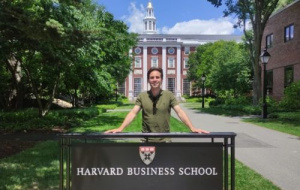 Research Training Grant report – Carlos Gonzales Perez (2021, DPhil Economics)
Carlos visited Harvard University between 16 March and 30 June 2026 and was hosted by Professor Davide Viviano from the Department of Economics.
The main objective of this research stay was to advance my doctoral research, strengthen collaborations with leading researchers in econometrics, and engage with the academic environment at Harvard and MIT. The primary focus of my visit was the development of my Job Market Paper, which constitutes the central component of my doctoral dissertation. Throughout the stay, I met regularly with Professor Viviano to discuss my progress and blockers within the project. His guidance and feedback turned out to be central to my work. Below I summarize the main technical outcomes of our work together.
The research developed during this period studies adaptive experimental design in clustered experiments under budget constraints. In many practical settings, researchers must decide how to allocate a fixed budget between sampling additional clusters and sampling additional units within existing clusters. This decision involves balancing statistical precision against data collection costs, with the optimal design depending on the unknown intra-cluster correlation (ICC). The main contributions obtained during my stay include the development of two pilot-based adaptive algorithms that implement near-optimal experimental designs without requiring prior knowledge of the ICC. Furthermore, under a symmetry assumption on the error distribution, I establish that standard inference on the population mean remains valid after conditioning on the adaptive designs generated by these algorithms. More generally, I show that asymptotic normality is preserved whenever adaptive data collection is driven by asymptotically even functionals of the data, such as sample variances, without requiring data splitting or statistical adjustments. This result extends beyond the proposed algorithms and provides a theoretical justification for widely used adaptive sampling procedures, including Neyman allocation after variance estimation. Finally, I show that the proposed algorithms achieve minimax-optimal performance up to logarithmic factors and uniformly outperform misspecified static sampling policies. Together, these results provide new theoretical foundations for adaptive sampling in clustered surveys and randomized controlled trials.
During the visit, I presented this research on two departmental events: the Internal Econometrics Seminar and the Workshop on Development Economics and Econometrics. Both presentations generated valuable discussions and constructive feedback from faculty members and graduate students, which contributed to further improving the paper.
Beyond my own research, I actively participated in the academic life of the department by regularly attending the joint Harvard–MIT seminars in Microeconomic Theory and Econometrics, as well as several graduate student workshops. These seminars exposed me to current research at the frontier of economics and provided opportunities to discuss ideas with researchers working across a broad range of topics. I also audited Professor Davide Viviano’s graduate course on Causal Inference and Recent Developments in Econometrics and Policy Design. The course complemented my doctoral training by introducing recent methodological advances directly related to my own research interests.
An equally valuable aspect of the visit was the opportunity to interact with faculty members and fellow PhD students at both Harvard and MIT. In particular, I had the opportunity to discuss my work with leading researchers, including Alberto Abadie (MIT), Rahul Singh (Harvard), and Max Cytrynbaum (Yale), among others. These interactions provided important perspectives on my research and allowed me to establish connections that I expect will continue beyond the duration of the visit.
Overall, the research stay exceeded my expectations and had a substantial positive impact on the progress of my doctoral research. The feedback received throughout the visit consistently highlighted the novelty and potential of my research agenda, as well as the quality of my presentations and communication skills. Professor Viviano expressed strong support for my future academic career and has agreed to write one of my recommendation letters for the academic job market. We also identified promising directions for future collaboration, particularly on projects related to adaptive bias identification. I am confident that the scientific advances achieved during this visit, together with the collaborations and professional network established at Harvard University, will significantly strengthen both my doctoral dissertation and my prospects on the academic job market.
You can find out more about the travel grants available to Univ students here.
Published: 16 October 2026
Explore Univ on social media