Machine learning and AI conference in Brazil
 Old Members’ Trust Graduate Conference and Academic Travel Fund report – – Keyan Miao (2021, DPhil Engineering Science)
In April 2026, I had the opportunity to attend the International Conference on Learning Representations (ICLR) in Rio de Janeiro, Brazil, with generous support from the Old Members’ Trust Graduate Conference and Academic Travel Fund. ICLR is one of the leading international conferences in machine learning and artificial intelligence, bringing together researchers from across deep learning, optimisation, reinforcement learning, generative modelling, and many related areas.
This trip was especially meaningful to me because it was the final academic conference of my DPhil. Over the course of my doctoral studies, my research has focused on the intersection between control theory and machine learning, particularly on how ideas from dynamical systems, stability, safety, and controllability can be incorporated into modern learning-based models. Attending ICLR at this stage of my PhD therefore felt both like a culmination of several years of research and an opportunity to see how this field is continuing to evolve.
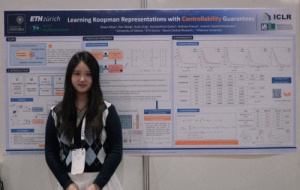
At the conference, I presented my recent work on incorporating control-theoretic structure into learned dynamical models. The poster session gave me the chance to discuss the work with researchers from both the machine learning and control communities, as well as with people approaching similar questions from different perspectives. These conversations were extremely valuable: some helped me think more carefully about the technical assumptions and possible extensions of my work, while others opened up broader discussions about how control-theoretic ideas can contribute to current challenges in AI.
One of the most exciting aspects of ICLR 2026 was seeing how increasingly visible control theory has become within the AI community. Many talks, posters, and informal discussions touched on themes closely connected to my own research, including dynamical systems, stability, safety, optimisation, sequential decision-making, and learning for control. As someone working at this interface, it was particularly encouraging to see these ideas gaining attention in a major AI venue. It also gave me a stronger sense that there are many new opportunities for dialogue between communities that have historically developed somewhat separately.
 The trip was also personally memorable. This was my first time visiting South America, and travelling from the UK to Rio de Janeiro was a long and demanding journey. Rio itself was unlike anywhere I had been before: a city of striking contrasts, with extraordinary natural beauty, intense urban energy, and a cultural atmosphere that felt completely new to me. Experiencing the city, even briefly, made the trip feel much broader than an academic visit alone. It was a reminder that conferences can be intellectually important, but also personally formative, especially when they take us to places and perspectives far beyond our usual environment.
I am deeply grateful to University College and the Old Members’ Trust for making this journey possible. Without this support, attending a conference so far away would have been very difficult. The grant enabled me to present my research at a major international venue, engage with a growing community around control and AI, and conclude my DPhil conference journey in a particularly meaningful and memorable way.
Published: 3 July 2026
Explore Univ on social media