
Univ Fellow awarded Royal Society Medal
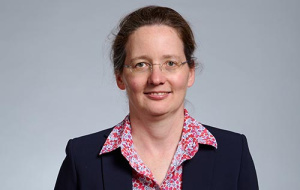
Professor Laura Herz – image courtesy of The Royal Society
Professor Laura Herz FRS, Univ Supernumerary Fellow in Physics, has been awarded the 2026 Royal Society Rumford Medal for outstanding contributions in the field of physics.
After completing a PhD in Physics at the University of Cambridge in 2002, Herz moved to a faculty position in Oxford in 2003, was made a Professor of Physics in 2010 and currently holds an EPSRC Open Fellowship. Professor Herz leads the Semiconductors Group in the Clarendon Laboratory in the Department of Physics. Her research explores how light interacts with novel semiconductor materials, with a particular focus on understanding the fundamental physical processes that determine how efficiently they convert sunlight into electricity.
Much of the group’s current work focuses on metal-halide perovskites, a new class of semiconductors that has transformed solar-cell research over the past decade because they can be made inexpensively while achieving exceptionally high efficiencies. More broadly, they are exploring newly emerging semiconducting materials and artificial molecular systems that harvest light in ways inspired by nature.
Ultimately, the goal is to provide the fundamental physical understanding needed to develop cleaner, more efficient technologies for solar energy generation and optoelectronic devices.
Professor Herz has received numerous awards for her research, including the Institute of Physics’ Michael Faraday Medal and Prize and has been listed by Clarivate Analytics as Highly Cited Researcher since 2018. She is a Fellow of the Royal Society, the Materials Research Society, the Royal Society of Chemistry and the Institute of Physics. Alongside her research, she is committed to mentoring early-career scientists and to supporting the wider research community through leadership, collaboration and public engagement.
Professor Herz said,
“I am deeply honoured to receive the Rumford Medal. The award highlights how curiosity-driven physics can make important contributions towards solving one of society’s greatest challenges: the development of affordable and sustainable energy technologies.
“This work would not have been possible without the creativity, dedication and generosity of the many outstanding students, postdoctoral researchers and collaborators with whom I have had the privilege to work over the years. I am sincerely grateful to them, and to the Royal Society, for this recognition.”
Published: 28 August 2026