From Turkey to Georgia and back
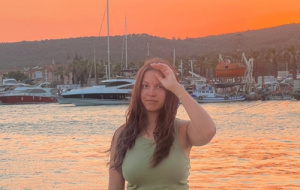
Raphaelle Martinez
Roger Short Memorial Fund Travel Diary – Raphaelle Martinez (2024, Law)
Thanks to the generosity of the Roger Short Memorial Fund, I travelled to Turkey and Georgia for two weeks in July 2025. I first landed in Istanbul where I met up with my old roommate and friend Defne, and we did the whole two-week journey together. Since she is Turkish, I was able to discover a more local and authentic side, and I hope that through my journal, you will get a true taste of Turkey. We moved between cities, historical sites, rural and beach towns. We began in Istanbul, a city at a crossroads not only geographically but culturally, with layers of history, and full if contradictions.
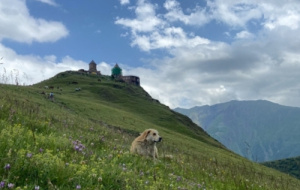
Gergeti Trinity Church in the background, in the Kazbegi region,
We then flew to Tbilisi, where the energy was palpable in the lively streets, warm summer nights, and vibrant artistic scene. From there, we visited the Kazbegi mountainous region and Kakheti, the wine-making region. Conversations with locals revealed anxieties about Georgia’s geopolitical position, and witnessing protests firsthand reminded me that travel is as much about listening as seeing. We then did a road trip along the Aegean coast in Turkey, visiting Defne’s grandmother in Balıkesir, seeing ancient ruins in Efes and fishermen towns like Cunda Adası. And finally, back to Istanbul.
I love food, and Turkey and Georgia arguably have two of the best cuisines in the world. So, I will share three of my favourite dishes that I tried (and that you should try too!).
Çiğ köfte: Çig köfte is a vegetarian version of “raw meatballs” made from fine bulgur wheat, tomato paste and various spices. You can get it in a wrap filled with çig ̆ kõfte, lettuce, tomato, and pomegranate molasses. Delicious. I had this on my first night in Istanbul, at a hole-in-the-wall place for roughly £1.
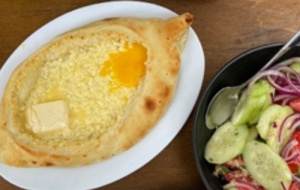
Adjaruli Khachapuri, one of my favorite Georgian dishes.
Adjaruli khachapuri: Probably the most rich and decadent Georgian food: doughy bread filled with cheese and butter, and with an egg yolk on top. I had this at a family-run restaurant in Stepantsminda, a small town in Kazbegi, the mountainous region in the North of Georgia.
Künefe: Finally, my absolute favourite is künefe. At my request, on my last night in Turkey, Defne’s parents bought künefe for dessert. It is a soft cheese covered in shredded pastry dough (kadayif), syrup, pistachios, and heated in the oven. Warm, cheesy, gooey and sweet. Delicious.
Furthermore, every day of my travels I learned a new local word or expression.
Gaumarjos (“cheers”): Georgia claims to be the first country to have ever made wine, so we were obliged to try their world-famous wine. We took a day tour to the Kakheti wine-making region where we had multiple wine tastings. Our tour guide, Gigi, taught us the word “gaumarjos” which means “cheers”. We learned that Georgians select a “toast master” who gives a toast before each glass of alcohol. The toast master says “gaumar”, we reply “jos”. This is repeated once, and then the final time he says “gaumar”, we say “jos, jos, jos”.
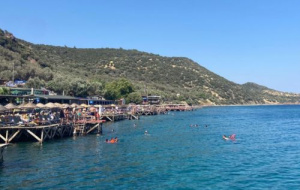
The beach in Assos
Çekirge (“cricket”): On the first day of our road trip along the Aegean Coast, we drove five hours from Istanbul to Assos, a quiet seaside town. That evening we went to a delicious “Rum” restaurant (local Greeks living in Turkey are called Rum). The drive back to the hotel was lovely: windows down, music blaring, sunroof open, stars above, just great. But then…we spotted a massive cricket in the car. Defne was terrified it would jump on her while driving and she would crash the car, but she couldn’t stop the car in the middle of the road. She asked me to help but I am apparently terrified of giant crickets too. Eventually, she pulled over. I was running around barefoot trying, and failing, to swat the cricket out. A man walked by, and we asked him for help. He quickly got the çekirge out of the car. Defne told him in Turkish, “you were sent from God”, and he replied, “no, I came by myself”.
Yangın (“fire”): On day 10 of the trip, we drove about three hours from Balıkesir (where Defne’s grandmother lives) to Ephesus Ancient City. On the drive there, we saw an active wildfire by the side of the road. “Yangın” is fire in Turkish. Helicopters flew overhead with large water balloons, trying to douse the flames, and firefighter planes circled above. I had never seen anything like it before —both fascinating and saddening. Thankfully the fire didn’t seem too big and hopefully it was quickly contained. Defne told me that this region sees a lot of wildfires, often poorly managed. We passed many charred landscapes which had suffered previous years’ fires.
Aile (“family”): Our road trip eventually ended, and we drove back to Istanbul. Defne’s parents, Banu and Izzet, had prepared a feast: lentil soup, vegetarian kebab for me, çiğ kõfte, köpoğlu (a cold mezze of potatoes, eggplant, yogurt, and tomato), cacik (yogurt and cucumber), hummus, and much more. Her mum even made me try rakı, which was too strong for me. I couldn’t help but make a face. “Aile” means family, as it is central in Turkish culture for all to gather around a home-cooked meal. Defne’s family welcomed me as one of their own, and this meal was such a thoughtful gesture. I am very grateful.
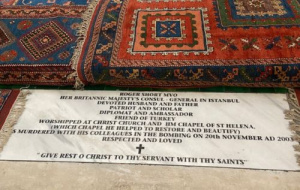
The memorial to Roger Short in the Crimean Memorial Church in Istanbul
Anı (“memory”): On my first evening in Istanbul, Defne’s parents asked me where the grant money came from. I explained what the Roger Short Memorial Fund was, and they told me they vividly remembered the 2003 attacks and knew who Roger and Victoria Short were. Therefore, on my last day in Turkey, we decided to go on a walk in remembrance of Roger Short. Our first stop was to see the British Consulate, one of the sites of the 2003 Istanbul bombings, where Roger Short was killed. We went to pay our respects. Our second stop was the Crimean Memorial Church, belonging to the Church of England, in the Beyoğlu neighbourhood. Inside the chancel is a memorial to Roger Short, which I was able to see thanks to a very kind man who let me in. Our third stop was to see the Doğan Apartments, beautiful yellow buildings with unique architecture, where Victoria Short once gardened. The word is therefore “anı”, meaning memory. First, in memory of Roger Short and his family. And second, because I will treasure the memories of this journey for a long time.
I hope I was able to share a little bit about my love for these two countries, their culture, their people, and their food. Finally, I would like to warmly thank the Roger Short Memorial Fund once again for giving me this opportunity, which has enriched me personally in ways I will carry forward for years to come.
Published: 13 August 2026
Explore Univ on social media