
In Memoriam: Professor Rudolph (Rudy) Marcus
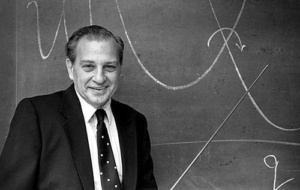 It is with great sadness that the College has received the news that Professor Rudy Marcus died on 16 July, just five days short of his 103rd birthday. Rudy was elected an Honorary Fellow in 1995, the same year that he received an honorary DSc from the University, and three years after the award of the Nobel Prize in Chemistry for his pioneering theoretical work on electron transfer. Previously he had been awarded the Wolf Prize in 1988 and had been elected a Foreign Member of the Royal Society in 1987.
Rudy’s first association with Univ took place twenty years earlier. After Charles Coulson had created a new Department of Theoretical Chemistry in 1972 and died two years later, Rudy was invited to Oxford in 1975 as a Visiting Professor in Theoretical Chemistry, associated with the College. When the Coulson Chair was formally established and attached to Univ, it was first offered to Rudy, but he declined for reasons that he explains in his contribution to the Oral History project at the California Institute of Technology where he was appointed in 1978 and in time became the John G Kirkwood and Arthur A Noyes Professor of Chemistry. He remained an active member of the faculty as one of the early beneficiaries of the abolition of mandatory retirement, lecturing until he was 95 and maintaining a research group until his death.
In a piece published on the Univ website to mark Rudy’s 100th birthday, two former Coulson Professors wrote tributes to Rudy’s work: Professor Mark Child, who had been responsible for the 1975 invitation, wrote:
“Rudy was by far the most distinguished theoretical chemist in my own immediate field, so I was delighted to be able to use the IBM fund to attract him to Oxford and John Albery was equally pleased attract him to Univ.”
and Professor David Logan, then not yet retired, contributed:
“Rudy Marcus is a scientific legend: a towering giant in the field of chemical theory, whose phenomenal intellectual legacy will continue to influence scientists for generations to come. Warm congratulations to him on the occasion of his 100th birthday!”
Rudy’s son, Alan, made a video of the interview that Professor Michael Collins carried out with Rudy at his home in Pasadena during a visit to Caltech earlier that year and this can be viewed there too. Caltech has published a full obituary covering Rudy’s life and work while Rudy’s entry in the Caltech Oral History project can be read here. The latter will make inspiring reading for all those seeking academic careers in the sciences.
Rudy’s wife, Laura, whom some may remember, died in 2003. He is survived by his three sons, Alan, Raymond and Ken. The College offers its sincerest condolences to them and their families.
Professor Michael Collins, Emeritus Fellow, writes:
“I first met Rudy in 1975 when we both lived at 104 Woodstock Road. In part because my wife had just moved from the United States, she and Laura immediately became friends and together explored the countryside, often with John McDowell’s wife who had also just come from the US. We saw Rudy and Laura occasionally when I spent a year at Caltech in 1979, but it was only when I visited again for the year 1990/91 and Rudy invited me to join one of the ‘Round Tables’ at the Atheneum – the closest to lunch at Univ, and the opportunity to meet those from other disciplines, as he put it – that I got to know him far better. But attendance there came at a price. That autumn, when John MacGregor as Education Secretary went to California on a fact-finding trip, Rudy was part of a small group assembled by the President of Caltech to meet him and he was keen to pick my brains on the British university system. So I was expected to expound, without preparation, at lunch. Similarly, when Margaret Thatcher resigned, I was asked to predict her successor (which I did correctly!).
“Rudy was very much an ‘old school’ theorist, working with pencil and paper, and leaving computations to others. But he was always working. We went skiing (one of his major relaxations, continuing with family trips into his 80s) one day – as, maybe surprisingly, one can in Southern California. After lunch, he pulled a muscle and, when I offered to drive straight back, he insisted that I continue and pulled some notes out of his rucksack so that he could work while I skied. Later that year, when we processed side-by-side at the Caltech Centenary Commencement addressed by President Bush, we talked about matrices, an area close to my heart, except that his were infinitely dimensional! And less than a year ago, I received an e-mail from him asking whether some three-by-three matrices with a particular property relevant to his work had a name. Indeed, after he fell ill and I wrote to Alan two months ago, he replied that his father was still working on two papers and talking to colleagues online.

Professor Michael Collins and Professor Rudy Marcus at Caltech
“Apart from a friendship spanning over fifty years, what I have to thank Rudy for most is that introduction to a ‘Round Table’. When I started visiting Caltech regularly just over twenty years ago, I found myself invited back as a regular member of what by then had become a single table, and this added immensely to my experience and knowledge of that institution.
“Although Rudy visited Oxford rarely, the last occasion being for John Albery’s 70th birthday celebration in 2006, he was immensely proud of his connection with us. He fondly remembers coming with his family to receive his honorary degree, and he chose his Oxford DSc robes for the Inauguration of Caltech’s President in 2014 when I was asked to represent the University.”
The College Flag has been flying at half-mast as a mark of respect.
Published: 28 July 2026