Professor Nancy Cartwright collects BBVA award
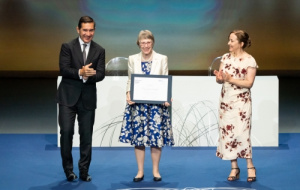
(Photo: BBVA Foundation)
Professor Nancy Cartwright, Centenary Visiting Professor in Philosophy, Politics and Economics (PPE) at the University of Oxford, collected the BBVA Frontiers of Knowledge Award for Humanities at a special ceremony held in Bilbao on 18 June. The ceremony of the 18th edition of the Frontiers of Knowledge Awards celebrated “the transformative power of science and culture to expand opportunities for progress in a world marked by complexity and uncertainty.” The event, which took place at Euskalduna Bilbao, honoured 10 individuals and two organisations in the global vanguard of scientific research and artistic creation.
The prestigious BBVA Frontiers of Knowledge Award for Humanities recognises Professor Cartwright’s use of philosophy to strengthen scientific rationality and to support the development of effective, evidence-based public policy.
On collecting her award, Professor Cartwright thanked the BBVA Foundation, the committee, her family, her colleagues and the interdisciplinary teams with which she has worked, as well as those who have supported her career.
During her speech, she gave a brief overview of her career and detailed some of the developments that drove her work in various directions.
She spoke about the impact her work has had on evidence-based policy and said,
“A final area where I hope my work has mattered is evidence-based policy. I believe the humanities are valuable in themselves, but also that they can, and should, be practically useful, especially philosophy. Philosophers have studied evidence and objectivity for centuries, developing nuanced understandings different from those of researchers studying miners’ lung disease or statistical methods for bias adjustment. But philosophical insights cannot be just dropped into practice. Progress comes when philosophy works with other expertise, including scientific and local experiential knowledge, to determine what objectivity demands in a specific case or what counts as good evidence that a policy will work.”
Professor Cartwright concluded her speech by drawing attention to the importance of interdisciplinary work.
She said,
“I end with a plea for interdisciplinarity. Nothing in science or philosophy does serious work on its own. Reliable achievements – whether a new law, device, concept or method – depend on many different forms of knowledge and methodology woven together. It takes a village to build an operating laser, a successful medical intervention or a reliable social policy.”


![Professor Nancy Cartwright collects BBVA award [photo: BBVA Foundation]](https://www.univ.ox.ac.uk/wp-content/uploads/2026/07/Ceremonia-XVIII-Premios-Fronteras-095-scaled.jpeg?gid=250 "Professor Nancy Cartwright collects BBVA award")
![Professor Nancy Cartwright collects BBVA award [photo: BBVA Foundation]](https://www.univ.ox.ac.uk/wp-content/uploads/2026/07/Ceremonia-XVIII-Premios-Fronteras-261-scaled.jpeg?gid=250 "Professor Nancy Cartwright collects BBVA award [photo: BBVA Foundation]")
![Professor Nancy Cartwright collects BBVA award [photo: BBVA Foundation]](https://www.univ.ox.ac.uk/wp-content/uploads/2026/07/Ceremonia-XVIII-Premios-Fronteras-098-scaled.jpeg?gid=250 "Professor Nancy Cartwright collects BBVA award [photo: BBVA Foundation]")
![Professor Nancy Cartwright collects BBVA award [photo: BBVA Foundation]](https://www.univ.ox.ac.uk/wp-content/uploads/2026/07/Ceremonia-XVIII-Premios-Fronteras-263-scaled.jpeg?gid=250 "Professor Nancy Cartwright collects BBVA award [photo: BBVA Foundation]")
Published: 6 July 2026
Explore Univ on social media