
Musical manuscript waste
If music be the food of love, rip it up and start again. This may have been what a past book conservator was thinking when they chose to mend the leaves of this 15th century missal with parchment from an entirely separate music manuscript. In this Treasure, we will take a look at some of the innovative repair work on display and investigate the musical score that has been used as bandaging.
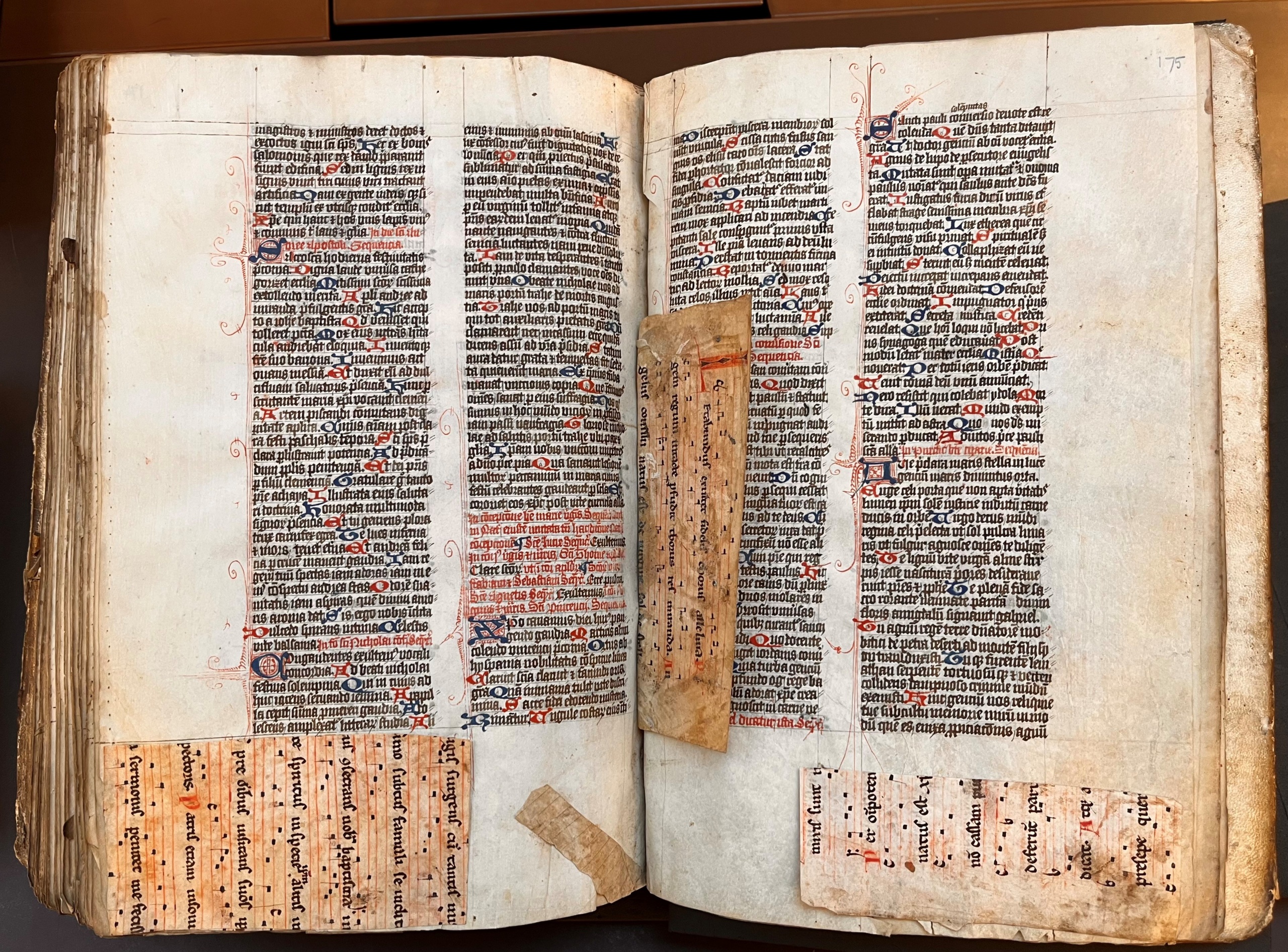
Folios 174 verso and 175 recto
The repaired volume, MS 78B, is a missal that originated from York Minster. We can locate it because it includes the York Feast of Relics — an “undeniably… ‘York’ book,” as Richard Pfaff puts it. Missals contain the liturgical texts needed to perform mass. It was gifted to the College by our previous Master, Thomas Walker, who died in 1665. Earlier provenance includes Margaret Haverham, whose obituary of 1532 is noted within, and William Sheppard, who gifted the manuscript to Cuckney Church in Nottinghamshire. As for the music manuscript, as yet we know nothing about its provenance, its age, or the larger work from which it was taken. Answering these questions is a tantalising prospect for future research.
It is not clear when these two manuscripts met, nor who might have collaged them together. What we can surmise is that the person was not a practised conservator. All of the repairs are what we would now call ‘visible repairs’. That is, the conservator has not tried to conceal their work by camouflaging it into the original material. Several of these visible repairs are quite charming: on folio 162 a fine tear, about 4 cm long, has been covered over with a thin strip of parchment that neatly isolates a few notes of the waste musical manuscript’s melody. On the verso, that same tear appears tidily held together. A very cute repair, but you may struggle to play the tune; when we compare this to the other appliquéd scraps of music waste, it appears the score has been pasted in upside down.
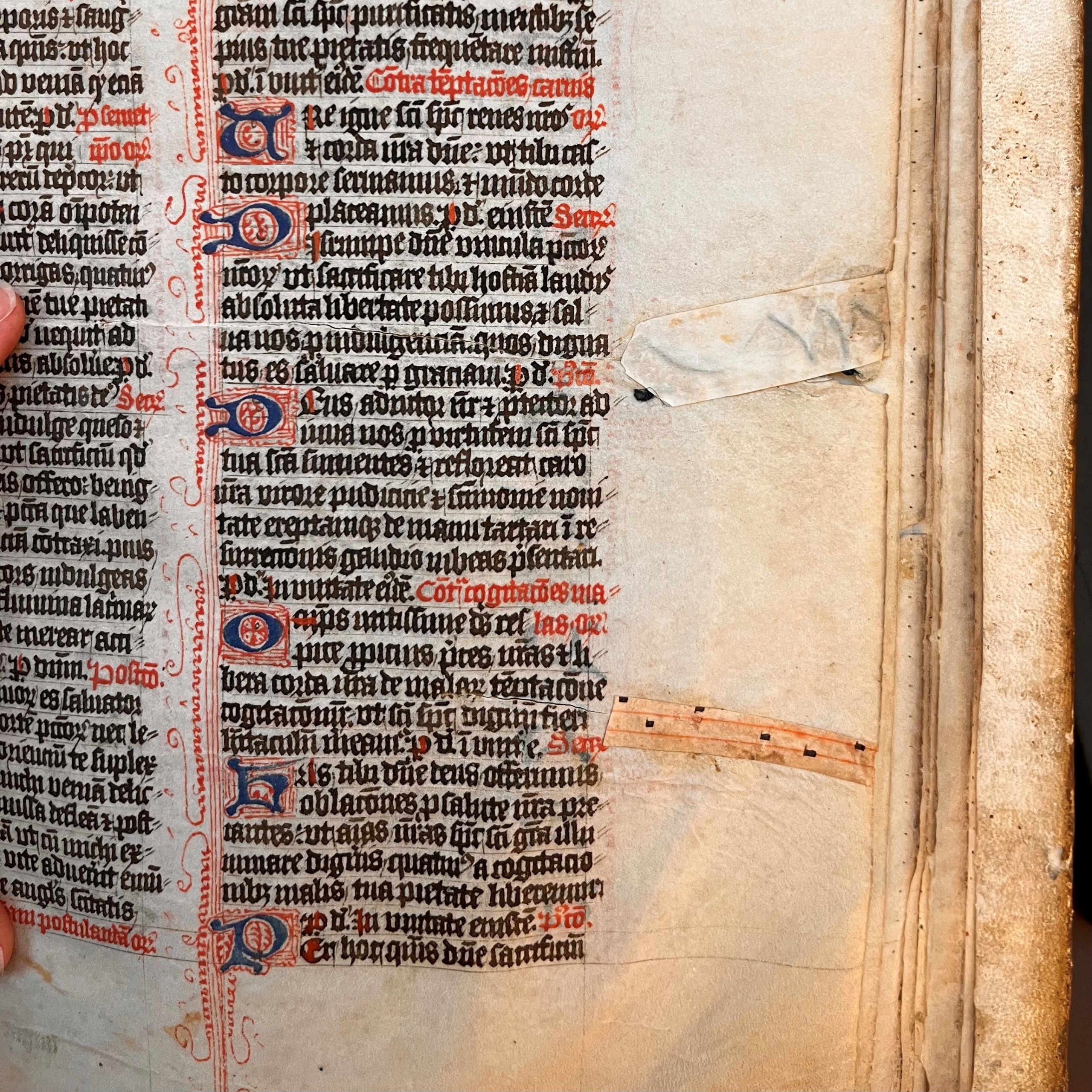
Folio 162 recto
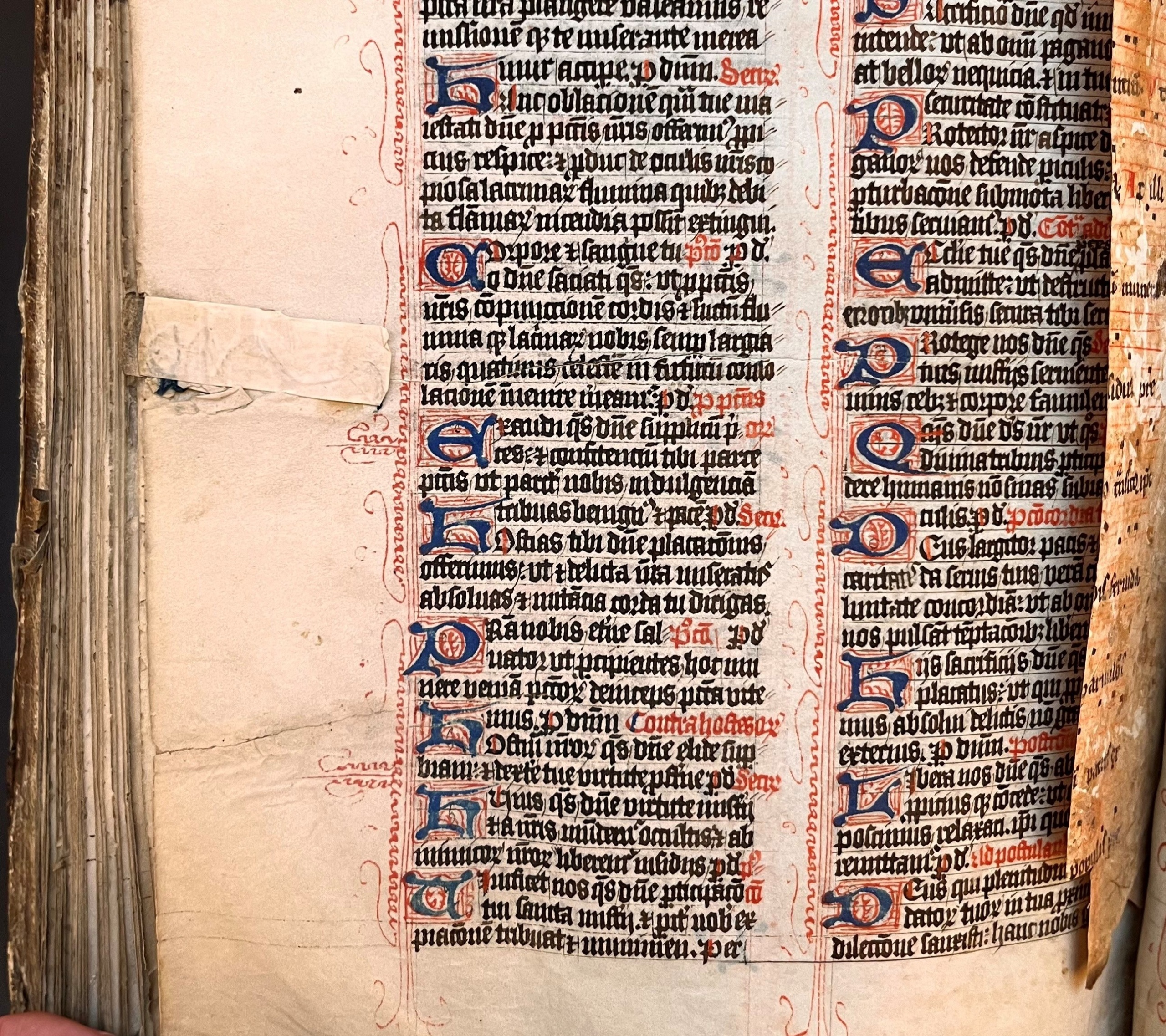
Folio 162 verso
In several instances, musical waste has been pasted in rather haphazardly. The gap from a large rip at the bottom of folio 166 has been obliquely patched over with a footer of musical parchment, with the large rectangle of material inelegantly pasted across the width of the page. This repair is made more glaring by the fact that the manuscript waste has (again!) been inserted upside down. On the verso, the upside down lyrics peep through to say hello.
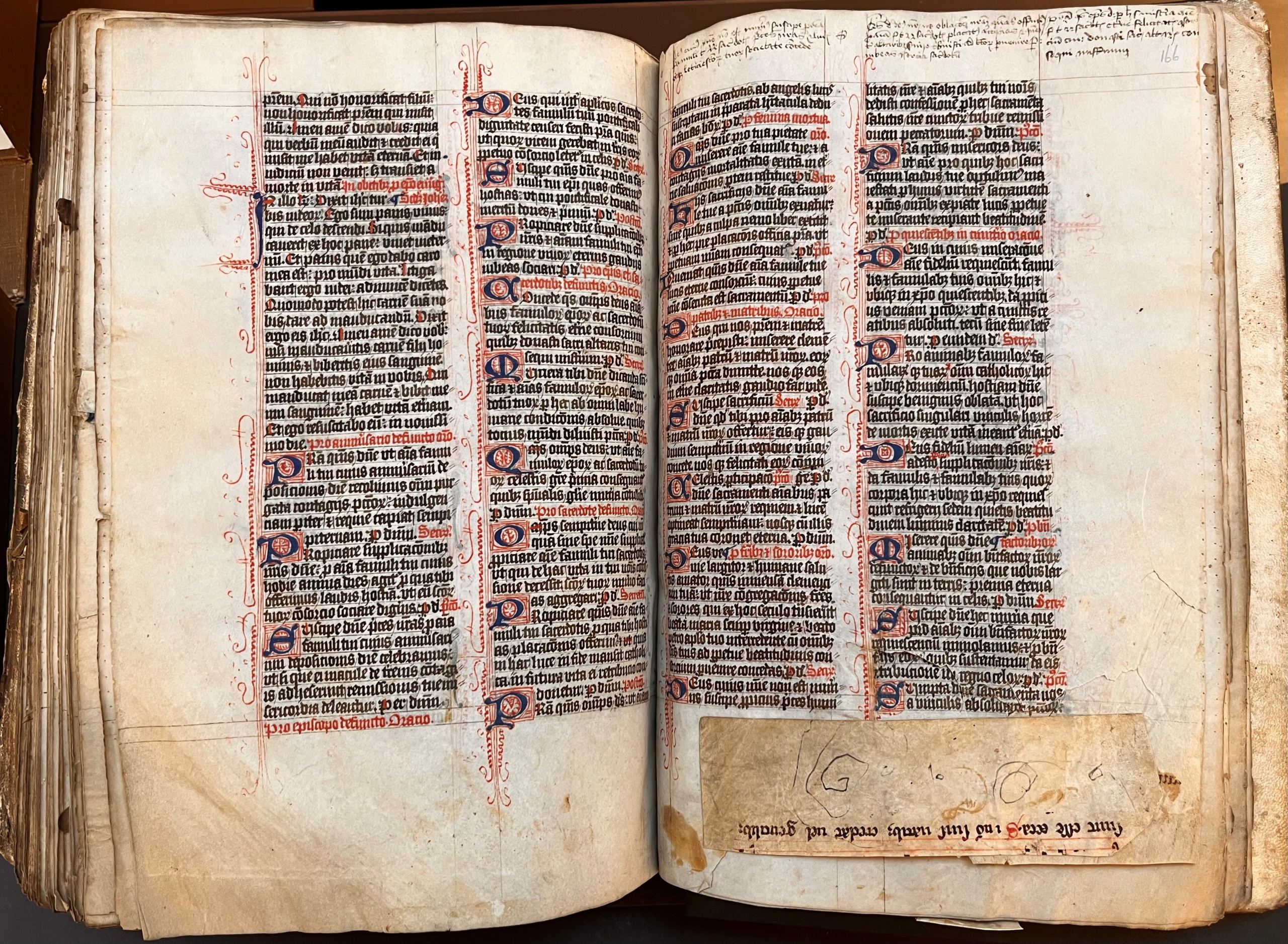
Folios 165 verso and 166 recto
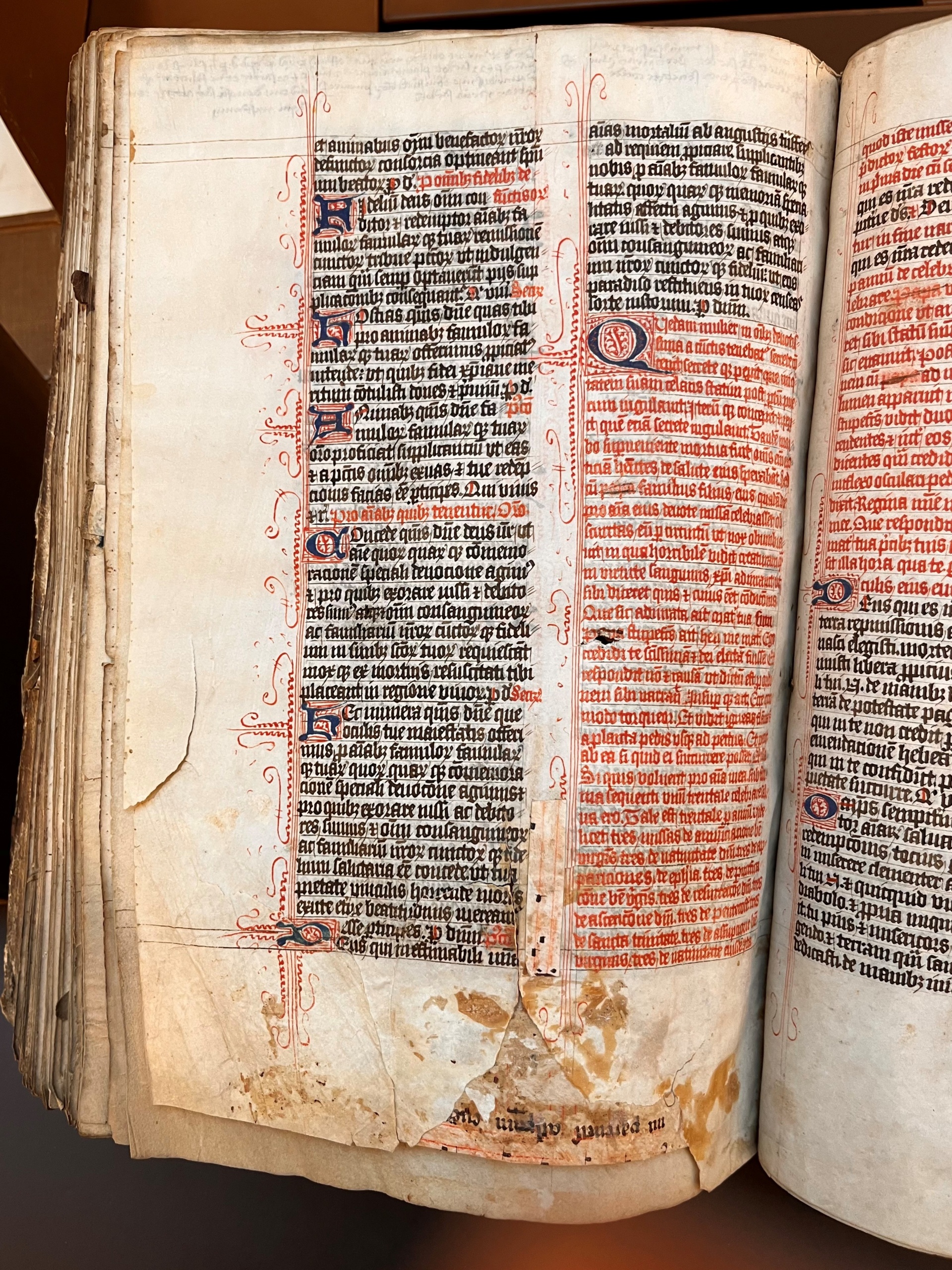
Folio 166 verso
Another notable quality of the repair is that the colours of the two parchments do not match. The missal’s parchment is a creamy white, and the colour is uniform on both sides of its folios; the musical parchment is more yellowy in colour, and is generally darker on one side than the other. These differences could indicate that the parchments come from two different species. The white missal is most likely calf skin, while the darker musical parchment is possibly sheep or goat which tend to be greasier (and therefore darker in colour) on the hairy side of the animal hide. Modern conservators prefer to mend manuscripts with matching materials, not just to disguise the repair but also so that the old and new materials will age and change in a similar way, limiting the chance of future damage.
What, then, of the music that penetrates this manuscript? More research is needed to identify the book (or other format for musical notation) that these fragments originally came from, and doing so would also help us understand when the music manuscript may have been produced. But there are some clues that we can use to identify the music that has been used as patching parchment.
Throughout much of the volume, the score has been cut in such a way that obfuscates the musical notes or removes too many lyrics to allow coherent identification. However, on folio 170 verso, covering damage at the top of the page, three words stand proud: semper rutilans sem.
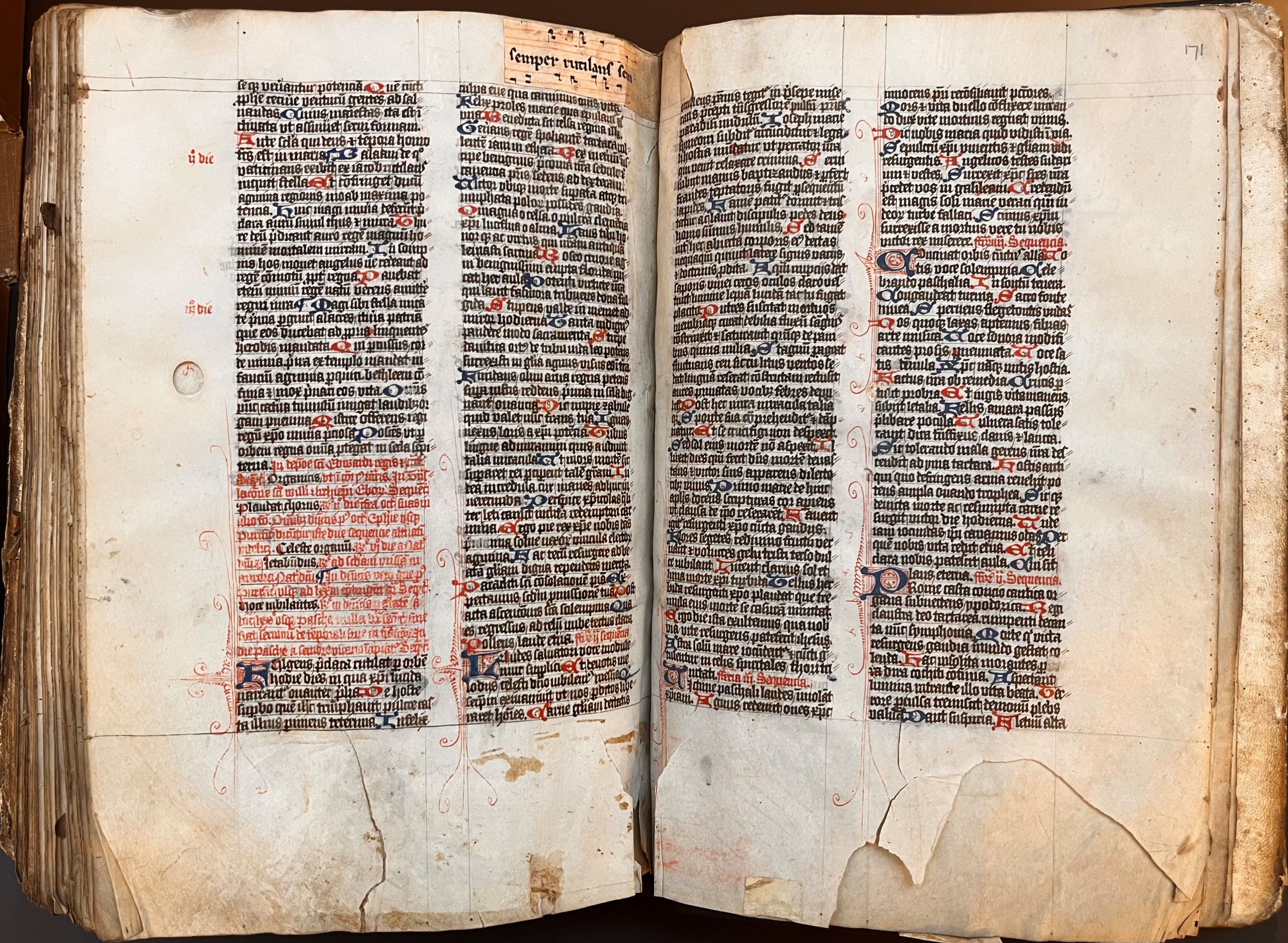
Folios 170 verso and 171 recto
Meaning “ever shining”, this is a truncation of the phrase stella semper rutilans, semper clara, or “a star ever shining, ever bright.” These words are taken from Letabundus, ‘Joy Abounding’, a sequence for Christmas.
More of Letabundus is pasted (at a 90° angle) on folio 174 recto, on the bottom right of the page. The first visible line of lyrics shows per clara, the elided part of semper clara that has carried over from the previous folio’s insertion.
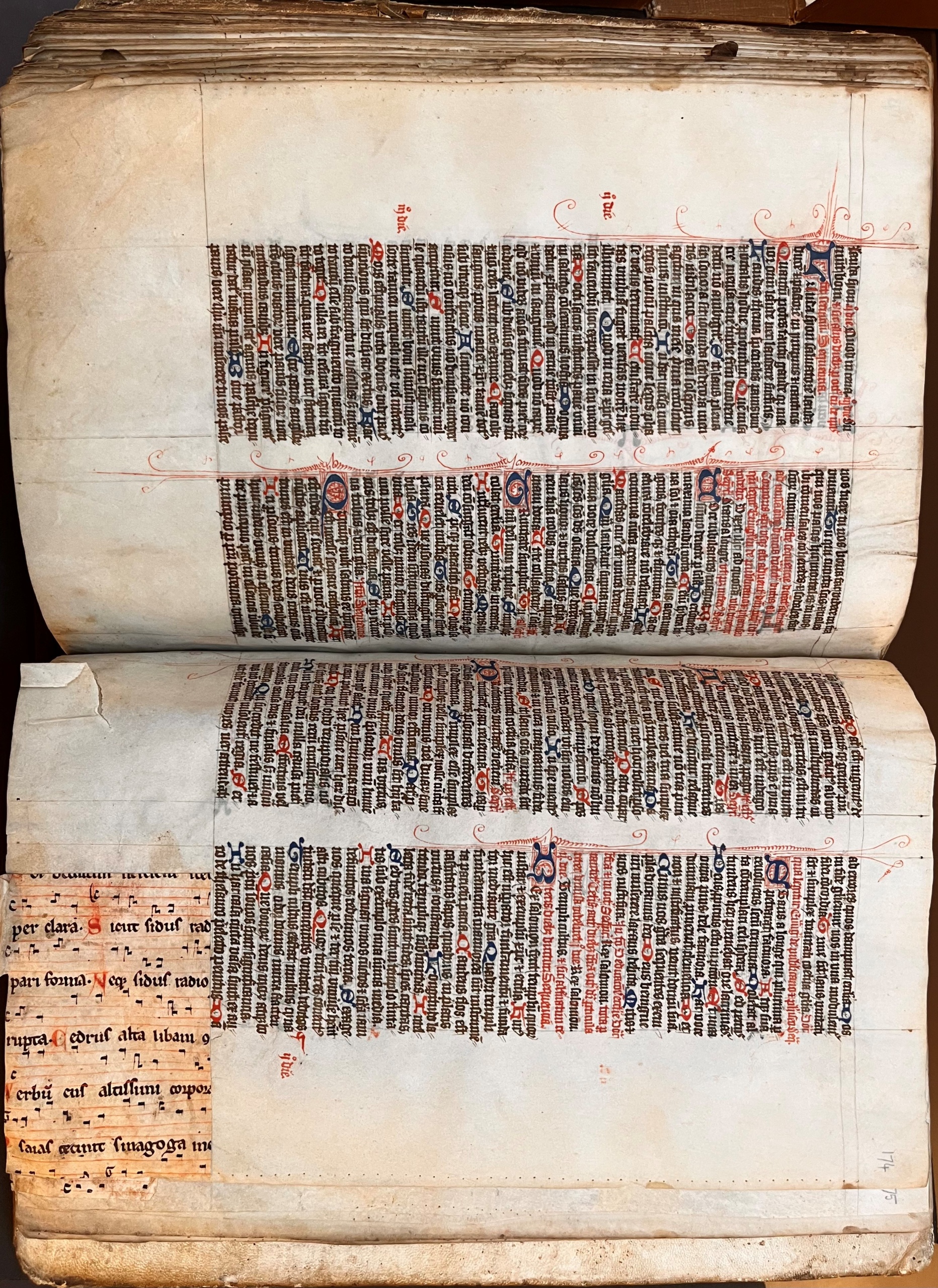
Folios 173 verso and 174 recto (90 degree angle)
This larger fragment of the musical score reveals more of the lyrics and melody, though with much of it again elided:
[sem]per clara. Sicut sidus rad[ium, profert Virgo Filium,] pari forma. Neque sidus radio, [neque mater filio, fit cor]rupta. Cedrus alta Libani [conformatur hyssopo valle nostra;] Verbum, mens altissimi, corporar[i passum est, carne sumpta.]
“…always bright. As a star its ray, the Virgin produces her Son, alike in form. Neither the star by its ray, nor the mother by her son, is corrupted. The tall cedar of Lebanon is formed by the low hyssop in our valley: the Word, the mind of the Highest, descended into a human body, having assumed flesh.”
The subsequent folios, 174 verso and 175 recto (pictured at the top of this article), each have a similarly sized fragment of music inserted in roughly the same place. The fragments on either side of folio 174 are stuck together, so it’s not possible to know if they are actually covering up any damage. Could there be some other significance to these insertions? Throughout the manuscript, there are instances of music being inserted between two folios in the middle of the page opening; these insertions are not in repair of damage, which begs the question, why are they there? Did the musical scores have some significance to the person treating this missal, beyond their usefulness as a repair material?
There is something curious about the manner (or manners) in which the music manuscript has been pasted in. With the small repair on folio 162, for example, the insertion is deliberate in its functionality but less thoughtful in application as it renders the music notation illegible. While many of the larger inserted fragments appear to be less functional, there seems to be a degree of deliberation in the extent to which the lyrics have been retained (albeit incompletely).
So, is it accurate to call this treatment ‘conservation’? Perhaps, instead, the person who treated this manuscript found some deeper significance in the music ‘waste’ as they handled and used it. We can’t know their motivations, but the result of their work is a wonderful collage of two manuscripts, with a couple of very cute and inspired repair jobs.
References and further reading :
University College MS 78B
Complete Latin lyrics and translation for Letabundus (note the translator’s comment that they have altered the hymn’s translation to remove “venomous barbs”) : https://www.blueheron.org/wp-content/uploads/2013/08/heron-101216w.pdf
Hear Blue Heron’s recording of Letabundus : https://www.youtube.com/watch?v=7zT21H5fg14
Complete score of Letabundus : https://www.gregorianum.org/wiki/Laetabundus_(Sequenza_natalizia_Domenicana)#Spartiti_musicali
An additional translation of Letabundus with more information about the hymn and its inclusion in Catholic rites : https://www.ccwatershed.org/2022/12/21/the-christmas-sequence-laetabundus/
J.J.G Alexander, Illuminated manuscripts in Oxford College libraries, the University Archives and the Taylor Institution (Oxford, 1985).
Jennifer A. Barnard, The Journey of the Soul: The Role of Music in the Ludus super Anticlaudianum of Adam de la Bassee https://research-information.bris.ac.uk/ws/portalfiles/portal/34503876/496042_VOL2.pdf
Michelle P. Brown, Illuminated manuscripts : a guide to technical terms (London, 1994).
Alexandra Gillespie and Daniel Wakelin, The production of books in England, 1350-1500 (Cambridge and New York, 2007).
Richard Pfaff, The liturgy in medieval England : a history (Cambridge, 2009).