Volcanology summer school in Portugal
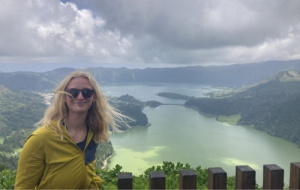
In front of the caldera lake of Sete Cidades volcano, São Miguel.
Old Members’ Trust Graduate Conference and Academic Travel Fund report – Elo Wilkinson-Rowe (2024, Environmental Research)
In May 2025, I attended the 2025 International Summer School on Geological Hazards on Volcanic Islands run by IVAR, the Research Institute for Volcanology and Risk Assessment, at the University of the Azores in Ponta Delgada, São Miguel, Azores. This was an eight-day long course providing teaching on different environmental hazards (eruptions, gas emissions, earthquakes, landslides, tsunamis) that populations are exposed to on volcanic ocean islands. The Azores are a group of nine volcanic islands situated on the Mid Atlantic Ridge and East Azores Fault Zone, each with several active volcanoes. Several eruptions have been experienced on the islands since settlement in the 15th century by Portuguese colonisers, and many of these volcanoes show signs of activity that indicate they may erupt again in the future.
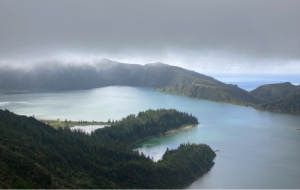
Fogo caldera lake, a central volcano on São Miguel on a foggy morning.
Researchers in volcanic hazards from across Europe were invited to IVAR for the summer school to teach us about the mechanisms and hazards of different types of volcanic eruptions. This focussed on utilising monitoring and hazard assessment data in practice, in collaboration with public authorities, to minimise local population exposure to dangerous hazards. The collection of students and researchers from interdisciplinary backgrounds, all working on different aspects of volcanic ocean islands, facilitated insightful conversations about the dynamic nature of these systems. I also had the opportunity to give both a poster and oral presentation to present some initial results from my PhD research, facilitating interesting and useful discussions with other students and researchers in the field to help advance my project.
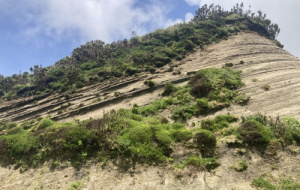
A proximal outcrop near the Sete Cidades caldera that preserves explosive eruption deposits from the last 5000 years.
A two-day field trip in the middle of the course, led by local experts from IVAR, took us to visit several of the volcanic systems on São Miguel, including Sete Cidades, Fogo, and Furnas (the three central caldera volcanoes) and the Picos fissural system which has erupted numerous scoria and tuff cones. We visited the large caldera lakes, several scoria cones and hydrothermal vents, and Europe’s only tea plantation! We were also given the exciting opportunity to deploy our own field equipment for monitoring diffuse CO2 soil outgassing, measuring water geochemistry, and a seismometer to monitor for changes in seismic activity. These can all provide vital early warning signs of volcanic unrest that allow the authorities to warn local people to evacuate if an eruption is likely.
This field course was highly useful and relevant to my PhD which I started in October 2024. I am part of a wider Leverhulme funded project called CAVES Africa based
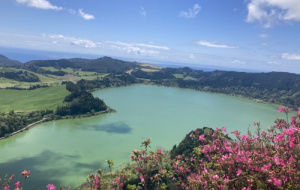
Furnas caldera lake (facing north), within the Furnas volcanic complex, on the eastern end of São Miguel.
in the School of Archaeology. This project hopes to use volcanic ash layers originating from the Azores and the Canary Islands to help constrain the timing of the environmental change and early human evolution in Northwest Africa over the last 300,000 years. It was a highly informative and opportune experience travelling to the Azores to visit many of the volcanic outcrops in person and learn more from local experts about the dynamics of these volcanic systems and their past eruption events. I’m very grateful to the Old Members’ Trust Graduate Conference and Academic Travel Fund for providing the funding for such a brilliant trip.
Published: 8 August 2025
Explore Univ on social media