Medical Elective in Cape Town
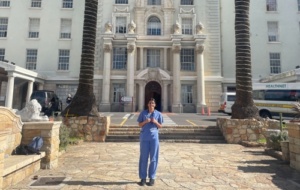
My first week at Groote Schuur Hospital
War Memorial Travel Fund report – Jaskiran Matharu (2019, Medicine)
I undertook my medical elective in the ICU of Groote Schuur Hospital in Cape Town, South Africa. The time I spent there was incredibly informative and eye-opening, and enabled me to see a side of medicine that I have never previously encountered in the UK. I was fortunate to gain a place in this hospital, which is renowned for being the location of the first ever human-to-human heart transplant. It is a public hospital, meaning it is government funded and therefore has fewer resources than its privately funded counterparts, but regardless is still a world-class hospital.
From my first day in the ICU I was confronted with cases that were deeply shocking. There were numerous patients hospitalised with multiple gunshot wounds and injuries resulting from community assault. I first learned of this concept on the ward round, where I found that in South Africa, alleged criminals are administered “justice” by their own community, who will beat the person severely as their punishment. These patients were often young men with severe facial fractures requiring ventilatory support. Other patients I encountered were seriously unwell due to drug use, whether that be overdoses or severe cellulitis from intravenous drug use, and some patients were admitted with conditions that are typically caught and managed early in the UK, but in South Africa can become very serious due to a lack of access to primary care.
The demographic of patients in the ICU also differed greatly from the UK. Almost every patient I saw reflected the deeply unequal society that prevails in South Africa as a relic of apartheid, which is that the vast majority of patients in public hospitals are low-income and black, whereas most patients in private hospitals are high-income and white. It is a disturbing disparity, and one that I felt deeply impacted not only hospital stays but long-term outcomes, as these patients would most likely receive no follow up or further care after discharge as they have little access to continuous care from a GP.
I learned a great deal about intense care medicine and was fortunate enough to be surrounded by a supportive team who gave ample opportunity to learn and practise skills. I was incredibly grateful for these opportunities to advance my skillset in such an encouraging environment. There was also regular teaching on the ward round and at lunchtimes, including journal clubs, presentations and simulations.

Exploring South Africa in my free time
Overall the placement enabled me to not only learn a great deal about intensive care medicine but also allowed me to improve my skills whilst developing a deeper understanding of global health and the difficulties faced in hospitals around the world.
Published: 18 July 2025
Explore Univ on social media